
How to Use AI Study Prompts to Pass TKT CLIL: A Structured Exam Preparation Guide
How to Use AI Study Prompts to Pass TKT CLIL: A Structured Exam Preparation Guide
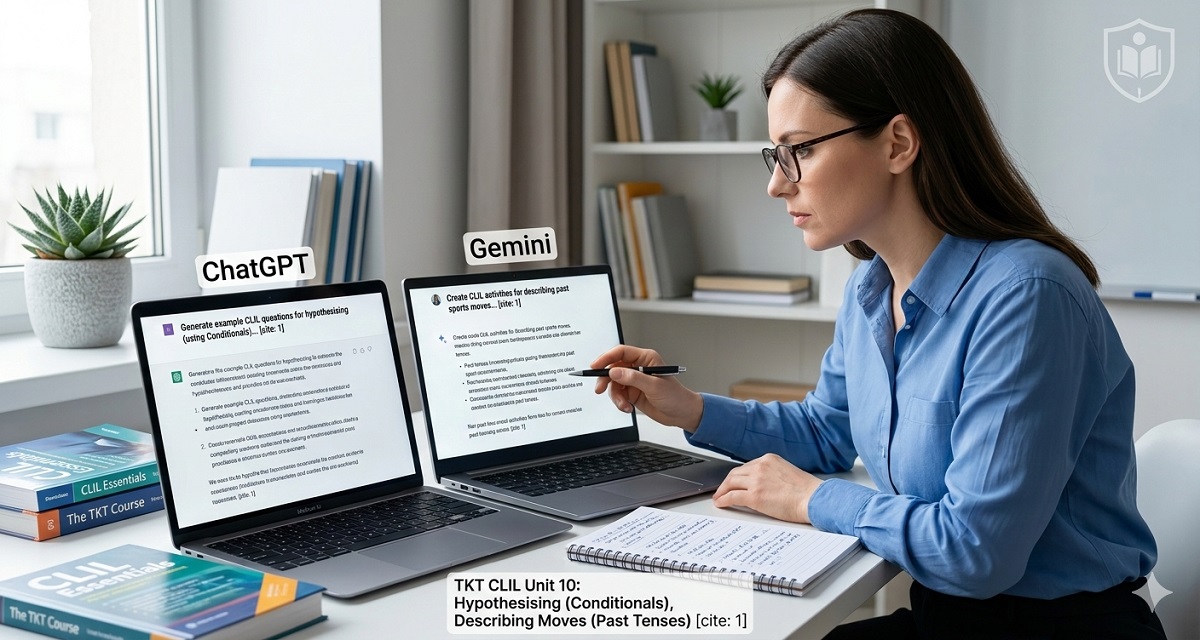
Preparing for the TKT: CLIL (Teaching Knowledge Test – Content and Language Integrated Learning) exam requires more than reading summaries. Cambridge assesses conceptual precision, terminology accuracy, and the ability to distinguish subtle pedagogical differences.
Many candidates fail not because they lack knowledge — but because they revise passively.
Below is a structured AI-driven system that transforms revision into exam simulation.
1️⃣ Unit Analyzer Prompt (Extract Exam-Relevant Core)
Use this prompt when starting a new unit.
Prompt Template:
I am studying TKT: CLIL.

Analyse [UNIT NUMBER / TITLE] and extract only what is exam-relevant.


Structure your response under these headings:


- Key testable concepts

- Core terminology (with precise exam-safe definitions)

- Common candidate confusions

- Typical TKT question formats this unit connects to

- High-probability distractors


Keep it focused on multiple-choice exam preparation.
This forces you to study strategically rather than broadly.
2️⃣ Micro Summary Prompt (5–7 Lines Revision)
Use this for final-week revision.
Create a 5–7 line ultra-condensed revision summary of [UNIT NUMBER / TITLE] for last-minute TKT CLIL review.


Only include:

- Core concepts

- Key terminology

- One common confusion


Avoid examples. Make it memorisation-friendly.
This improves recall speed under exam pressure.
3️⃣ Structured Summary Prompt (Full Study Version)
Use after completing the Unit Analyzer.
Create a structured study summary for [UNIT NUMBER / TITLE] aligned with TKT: CLIL exam preparation.


Include:

- Key definitions

- Main principles

- Content vs language focus (if applicable)

- Cognitive dimension (LOTS/HOTS if relevant)

- Classroom strategies mentioned

- How this unit typically appears in exam questions


Use bullet points for clarity.
This builds conceptual depth.
4️⃣ Application & Exam Trap Analysis Prompt
Cambridge tests subtle differences.
For [UNIT NUMBER / TITLE], explain how Cambridge might test this in multiple-choice questions.


Provide:

- 3 example exam-style scenarios

- The correct answer for each

- Why distractors might look correct

- What concept students usually misunderstand


Focus on subtle distinctions.
This develops exam instinct.
5️⃣ Confusion-Check Prompt (Concept Contrast)
TKT CLIL often tests contrast between similar ideas.
In [UNIT NUMBER / TITLE], identify 3 concepts that are commonly confused.


For each pair:

- Define both clearly

- Explain the difference in one precise sentence

- Provide one mini exam-style question testing the distinction


Keep definitions aligned with TKT terminology.
This reduces careless mistakes.
6️⃣ Cross-Unit Connection Prompt
Cambridge frequently blends units.
Compare [UNIT NUMBER / TITLE] with:


Unit X

Unit Y


Show:

- Conceptual overlaps

- Key differences

- How exam questions may mix these concepts

- One example of a misleading exam distractor combining them


Present in comparison table format.
This prevents oversimplified thinking.
7️⃣ Practice Question Generator Prompt
Active practice is critical.
Create 8 TKT: CLIL style questions based on [UNIT NUMBER / TITLE]:


- 3 matching questions

- 3 multiple-choice scenario questions

- 2 aim-identification questions


Provide answer key separately at the end.


Ensure distractors are realistic and conceptually close.
This simulates real exam pressure.
8️⃣ Self-Evaluation Prompt
After writing your own notes:
I will paste my summary of [UNIT NUMBER / TITLE] below.


Evaluate it for:

- Conceptual accuracy

- Alignment with TKT exam language

- Missing key terminology

- Over-generalisation

- Confusion between pedagogy and methodology


Suggest corrections only where necessary.
This improves precision.
9️⃣ Final Brain-Sheet Compression Prompt
For last 48-hour revision:
Compress [UNIT NUMBER / TITLE] into a one-page “exam brain sheet” containing:


- Essential terminology

- One-sentence definitions

- Core distinctions

- High-frequency exam themes


No explanations. Just memory triggers.
Perfect for rapid recall.
🔟 Mastery-Level Prompt (Deep Understanding)
To ensure full conceptual mastery:
Teach [UNIT NUMBER / TITLE] to me as if I must explain it to other teachers preparing for TKT CLIL.
Include:
- Theoretical foundation
- Why this concept matters in CLIL classrooms
- How it links to cognition and language
- How exam writers test this concept
Make it conceptually rigorous.
Teaching others solidifies understanding.
Weekly Strategic Plan
Day 1 → Unit Analyzer
Day 2 → Structured Summary
Day 3 → Confusion Check + Practice Questions
Day 4 → Self-Test
Weekend → Brain Sheet Compression
This transforms AI from summary generator into exam trainer.
Why This Approach Works
TKT CLIL is not about memorizing examples.
It tests:
-
Terminology accuracy
-
Conceptual distinction
-
Cognitive understanding
-
Application judgment
Structured prompting builds these skills directly.
Final Thought
AI should not replace thinking.
It should sharpen it.
Used strategically, these prompts help TKT CLIL candidates revise actively, identify exam traps, and build confidence before test day.