NotebookLM vs ChatGPT for TKT CLIL Exam Preparation: What Actually Works?
Article Outline
-
H1: NotebookLM vs ChatGPT for TKT CLIL Exam Preparation: What Actually Works?
-
H2: The Reality of Preparing for the TKT CLIL Exam
-
H3: Why Teachers Turn to AI Tools for Exam Preparation
-
H3: The Challenge of Studying CLIL Effectively
-
-
H2: My Experience Using ChatGPT for TKT CLIL
-
H3: How I Used ChatGPT for Study and Summaries
-
H3: When ChatGPT Started to Break Down
-
-
H2: Testing Gemini for CLIL Exam Preparation
-
H3: What Gemini Did Well
-
H3: Limitations of Gemini for Exam-Focused Learning
-
-
H2: Why NotebookLM Worked Better for Me
-
H3: Source-Based Learning and Accuracy
-
H3: Slides, Summaries, and Exam Insights
-
-
H2: Comparing AI Tools for TKT CLIL Preparation
-
H3: Key Differences Between ChatGPT, Gemini, and NotebookLM
-
-
H2: Lessons for ICT and Computer Science Educators
-
H3: Applying This Workflow in Teaching and Training
-
-
H2: Practical Strategy for Using AI in Exam Preparation
-
H3: A Simple Workflow That Actually Works
-
-
H2: Recommended Resources for TKT CLIL Preparation
-
H3: Sample Paper and Study Notebook
-
-
H2: Conclusion
-
H2: FAQs
-
NotebookLM vs ChatGPT for TKT CLIL Exam Preparation: What Actually Works?
The Reality of Preparing for the TKT CLIL Exam
Preparing for the TKT CLIL exam is not just about memorizing theory—it’s about understanding how to apply Content and Language Integrated Learning (CLIL) in real classroom situations. For many teachers, especially those working in ICT and computer science education, this can feel overwhelming. You’re not just learning teaching strategies; you’re learning how to combine subject knowledge with language instruction, which requires a completely different mindset.
In recent years, many educators have turned to AI tools like ChatGPT and Gemini to simplify their study process. The idea sounds perfect: upload your study material, ask questions, generate summaries, and get instant explanations. In theory, this should save hours of reading and help you focus on what matters most—understanding exam-style questions.
But here’s the reality: not all AI tools perform equally well when it comes to exam-focused preparation. Some tools are excellent for general explanations but struggle when you need accuracy, consistency, and direct references to study materials. This becomes especially important in exams like TKT CLIL, where understanding the reasoning behind answers is critical.
Teachers preparing for this exam often search for ways to connect theory with practice. They want to know not just what CLIL is, but how to answer questions like:
-
Why is this teaching strategy correct?
-
Which part of the book supports this answer?
-
How do I apply this in a real classroom?
This is where the choice of AI tool can make a huge difference. In my own preparation journey, I tested multiple tools—ChatGPT, Gemini, and NotebookLM—to see which one actually helps with structured learning. What I discovered wasn’t what I expected.
Why Teachers Turn to AI Tools for Exam Preparation
The appeal of AI tools in education is easy to understand. Teachers are busy, and preparing for certifications like Cambridge TKT CLIL requires time, focus, and access to the right resources. AI promises to simplify this process by acting as a personal tutor, available anytime.
For ICT educators, this is even more relevant. Many are already familiar with digital tools and are comfortable experimenting with new technologies. Using AI for exam preparation feels like a natural extension of their teaching practice.
AI tools can:
-
Summarize complex content
-
Explain difficult concepts
-
Generate practice questions
-
Provide instant feedback
These features make them attractive for exam preparation. However, the effectiveness of these tools depends heavily on how they handle source material and context. If an AI tool cannot maintain consistency or accurately reference your study content, it can actually slow down your preparation instead of helping it.
The Challenge of Studying CLIL Effectively
CLIL is not a straightforward subject. It involves multiple layers, including language acquisition, subject pedagogy, cognitive development, and classroom interaction. This complexity makes it difficult to study using traditional methods alone.
For example, understanding the 4Cs framework (Content, Communication, Cognition, Culture) is one thing. Applying it to a real exam question is another. Teachers need to recognize how these concepts appear in different contexts and how to select the correct answer based on subtle differences.
This is why many candidates look for tools that can:
-
Break down exam questions
-
Explain reasoning clearly
-
Link answers to specific parts of the study material
Without this level of support, preparation can become inefficient and frustrating. And this is exactly what happened when I started using AI tools for my own study process.
My Experience Using ChatGPT for TKT CLIL
When I first started preparing for the TKT CLIL exam, ChatGPT seemed like the perfect solution. I uploaded my study material and began asking targeted questions, focusing on summaries and exam preparation.
How I Used ChatGPT for Study and Summaries
My approach was simple but structured. I fed ChatGPT with the CLIL book and started asking questions like:
-
“Summarize this chapter for exam preparation”
-
“Which part of the book explains this concept?”
-
“How does this relate to TKT CLIL exam questions?”
At the beginning, the results were impressive. The summaries were clear, and the explanations seemed helpful. It felt like I had a personal tutor guiding me through the material.
This approach worked particularly well for understanding general concepts. For example, ChatGPT could explain the difference between BICS (Basic Interpersonal Communication Skills) and CALP (Cognitive Academic Language Proficiency) in a simple and accessible way.
When ChatGPT Started to Break Down
However, after about two days, I started noticing a problem. The quality of the responses began to decline. Some summaries became vague, while others included information that didn’t match the original content.
In some cases, ChatGPT provided answers that sounded correct but were actually misaligned with the source material. This is a critical issue when preparing for an exam, where accuracy matters more than fluency.
I tried restarting the chat and repeating the process, hoping to reset the system. While this improved things slightly, the inconsistency remained. This made it difficult to trust the answers fully, especially when dealing with exam-style questions that require precise understanding.
Testing Gemini for CLIL Exam Preparation
After facing inconsistencies with ChatGPT, I decided to try Google Gemini as an alternative. Since it’s also a powerful AI tool, I expected it to handle structured learning and exam preparation more effectively. Many educators are now experimenting with multiple AI tools, hoping to find the one that best fits their workflow.
What Gemini Did Well
At first glance, Gemini performed reasonably well. It was able to generate summaries, explain CLIL concepts, and respond to general questions about teaching strategies and methodology. For example, when I asked about scaffolding techniques or the role of language in CLIL classrooms, the responses were clear and easy to understand.
Gemini also handled shorter tasks efficiently. If I needed a quick explanation or a simplified version of a concept, it delivered results that were comparable to ChatGPT. This made it useful for quick revisions or refreshing basic knowledge.
Another advantage was its integration with Google tools, which can be helpful for educators already working within that ecosystem. For teachers managing documents, slides, and notes, this can create a smoother workflow.
However, when it came to deep, exam-focused preparation, things started to fall short.
Limitations of Gemini for Exam-Focused Learning
The biggest limitation I faced with Gemini was lack of precision in linking answers to source material. While the explanations were generally correct, they often felt too broad or generic. For an exam like TKT CLIL, this is not enough.
You don’t just need to understand a concept—you need to:
-
Know why a specific answer is correct
-
Identify where it comes from in your study material
-
Apply it to specific exam questions
Gemini struggled with this level of detail. It could explain CLIL concepts, but it didn’t consistently connect those explanations to exam-style reasoning.
Another issue was the limitation in the free version. Compared to ChatGPT, I found myself restricted in how many questions I could ask or how deeply I could explore certain topics. This made it harder to build a continuous study flow.
At this point, I realized something important:
Not all AI tools are designed for structured, source-based learning.
And that’s when I tried NotebookLM.
Why NotebookLM Worked Better for Me
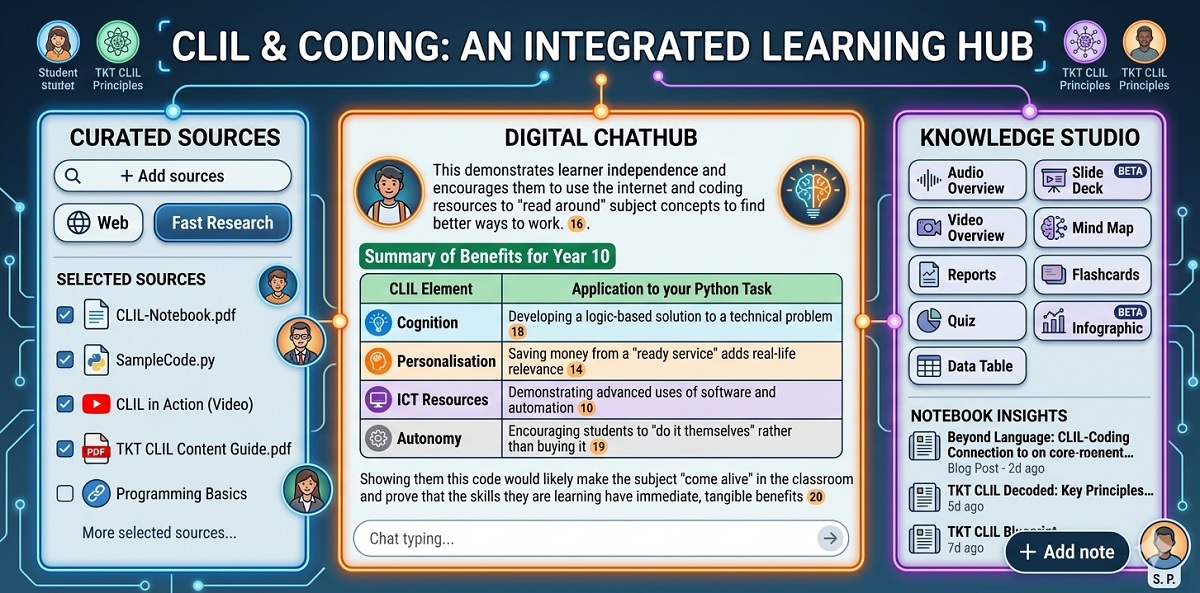
When I started using NotebookLM, the difference was immediately noticeable. Unlike general AI tools, NotebookLM is designed specifically for working with your own sources, which makes it far more effective for exam preparation.
Source-Based Learning and Accuracy
The biggest advantage of NotebookLM is that it grounds its answers in the material you provide. Instead of generating general responses, it pulls directly from your uploaded sources and builds answers based on that content.
This completely changed my study experience.
When I asked questions like:
-
“Why is this answer correct?”
-
“Which part of the book explains this concept?”
NotebookLM was able to:
-
Reference specific sections
-
Provide accurate explanations
-
Stay consistent across multiple questions
This level of accuracy is crucial for exams like TKT CLIL, where understanding the reasoning behind answers is more important than memorizing definitions.
It felt less like using a chatbot and more like having a structured study assistant that actually understood my material.
Slides, Summaries, and Exam Insights
Another feature that stood out was the ability to generate automatic slides and structured summaries. These weren’t just basic summaries—they were organized in a way that made revision easier.
For example, NotebookLM could:
-
Break down complex topics into clear points
-
Highlight key concepts for revision
-
Organize information in a logical flow
This is especially useful for teachers who prefer visual learning or need quick revision before the exam.
Even more importantly, NotebookLM helped connect theory to exam questions. It didn’t just explain concepts—it showed how those concepts apply in practice. This made it much easier to understand how to approach different types of questions in the TKT CLIL exam.
Comparing AI Tools for TKT CLIL Preparation
Choosing the right AI tool can significantly impact how efficiently you prepare for exams. Based on my experience, each tool has its strengths and limitations.
Key Differences Between ChatGPT, Gemini, and NotebookLM
| Feature | ChatGPT | Gemini | NotebookLM |
|---|---|---|---|
| General explanations | Strong | Strong | Good |
| Consistency over time | Medium | Medium | High |
| Source-based answers | Limited | Limited | Excellent |
| Exam-focused learning | Medium | Medium | High |
| Summary quality | Variable | Moderate | High |
| Study workflow support | Moderate | Limited | Excellent |
The table makes one thing clear:
If your goal is structured exam preparation, especially for something like TKT CLIL, NotebookLM offers a significant advantage.
Lessons for ICT and Computer Science Educators
For educators in ICT and computer science, this experience goes beyond exam preparation. It highlights how different AI tools can be used for different purposes in both teaching and learning.
Applying This Workflow in Teaching and Training
In a classroom setting, especially in computer science education, teachers often deal with complex topics that require both conceptual understanding and practical application. AI tools can support this process—but only if used correctly.
For example:
-
ChatGPT can help explain programming concepts
-
Gemini can assist with quick summaries
-
NotebookLM can support structured learning from specific materials
Imagine teaching Python or algorithms using CLIL methodology. Students need to understand both the technical concept and the language used to describe it. A tool like NotebookLM can help bridge this gap by linking explanations directly to learning materials.
This approach aligns perfectly with CLIL principles, where content and language are integrated rather than taught separately.
Practical Strategy for Using AI in Exam Preparation
After testing multiple tools, I realized that the key is not choosing one tool over another—but using them strategically.
A Simple Workflow That Actually Works
Here’s a practical approach that can save time and improve results:
-
Use NotebookLM for:
-
Studying from your main materials
-
Understanding exam questions
-
Linking answers to sources
-
-
Use ChatGPT or Gemini for:
-
Quick explanations
-
Brainstorming ideas
-
Simplifying difficult concepts
-
-
Combine both approaches:
-
Study deeply with NotebookLM
-
Clarify doubts with ChatGPT
-
This hybrid strategy allows you to take advantage of each tool’s strengths while avoiding their weaknesses.
📊 TKT CLIL Slide Resources for Deeper Learning
To support your preparation for the TKT CLIL exam, here are structured slide decks that break down key concepts, exam strategies, and common mistakes.
These resources are especially useful for ICT and computer science educators who prefer visual learning and quick revision formats.
1. TKT CLIL Exam Blueprint: Structure, Topics & Preparation Guide
This slide deck explains the overall structure of the TKT CLIL exam, including key topics, question types, and preparation strategies.
👉 [Slide Link Here]
2. TKT CLIL Exam Preparation Study Guide | CLIL Mastery Toolkit
A more detailed breakdown of CLIL concepts, teaching strategies, and exam-focused insights to help you build confidence before the test.
👉 [Slide Link Here]
3. TKT CLIL Sample Questions and Common Mistakes Explained
This resource focuses on real exam-style questions, highlighting common mistakes and how to avoid them.
👉 [Slide Link Here]
Recommended Resources for TKT CLIL Preparation
Preparing effectively requires access to the right materials. Here are some key resources:
Sample Paper and Study Notebook
-
TKT CLIL Sample Paper
https://www.scribd.com/document/257359709/22192-Tkt-Clil-Sample-Paper -
CLIL Study Notebook (NotebookLM)
https://notebooklm.google.com/notebook/38efcea7-c52e-43a2-ad71-1842a7d4eabe
These resources can help you understand the exam format and practice applying CLIL concepts.
Recommended YouTube Videos
Case Studies in CLIL and AI-Supported Learning
One example comes from European bilingual schools, where CLIL is widely used in STEM education. Teachers integrating digital tools into their classrooms found that structured platforms improved student comprehension more than generic tools.
Another case involves teacher training programs in Central Asia, including Kyrgyzstan, where educators are beginning to adopt AI tools for lesson planning and exam preparation. Early findings suggest that tools grounded in specific learning materials provide better outcomes.
Related Reddit Discussions
-
https://www.reddit.com/r/TEFL/comments/12k7j3/clil_teaching_experience/
-
https://www.reddit.com/r/Teachers/comments/1d0l8p/clil_method_in_classrooms/
-
https://www.reddit.com/r/TEFL/comments/1bbv7f/preparing_for_tkt_exam/
Conclusion
Preparing for the TKT CLIL exam requires more than just understanding theory—it requires the ability to apply concepts accurately and consistently. While AI tools can significantly support this process, not all tools are equally effective.
From my experience, NotebookLM stands out for structured, source-based learning, while ChatGPT and Gemini remain useful for general support. The key is to use each tool strategically, depending on your goals.
FAQs
1. Is NotebookLM better than ChatGPT for exam preparation?
It depends on the task, but for source-based and exam-focused learning, NotebookLM performs better.
2. Can I pass TKT CLIL using AI tools only?
AI tools can support your preparation, but you still need to understand CLIL methodology and practice questions.
3. Which AI tool is best for teachers?
A combination works best—NotebookLM for structured learning and ChatGPT for quick explanations.
4. Is CLIL important for ICT teachers?
Yes, especially in international and bilingual education environments.
5. How should I start preparing for TKT CLIL?
Begin with study materials, sample papers, and structured tools like NotebookLM
Author Bio
Ahmed Elmalla is a Computer Science educator, Certified Cambridge International AS & A Level Computer Science (9618) teacher, and software engineer with over 20 years of teaching, software engineering, and international tutoring experience. He specializes in AP Computer Science A (Java) and Cambridge IGCSE (0478) and AS & A Level Computer Science (9618), helping students build strong programming, computational thinking, and exam-solving skills. Through his Learn with Kemo platform, he has mentored students from around the world using practical, exam-focused instruction tailored to each learner's needs. His lessons combine real-world software engineering experience with personalized one-to-one tutoring, making complex Java and Computer Science concepts easier to understand. Ahmed is passionate about helping students gain confidence, improve academic performance, and achieve outstanding results in international Computer Science examinations.
LinkedIn: https://www.linkedin.com/in/akelmalla
WhatsApp: https://wa.me/60194028484