TKT CLIL Unit 10 Explained: Comparing ChatGPT vs Gemini for CLIL Exam Preparation
TKT CLIL Unit 10 Explained: ChatGPT vs Gemini for Exam Preparation
Artificial intelligence tools like ChatGPT and Gemini are increasingly used by teachers preparing for professional certifications such as Cambridge TKT: CLIL (Teaching Knowledge Test – Content and Language Integrated Learning).
But an important question emerges:
Which AI provides better exam-focused explanations?
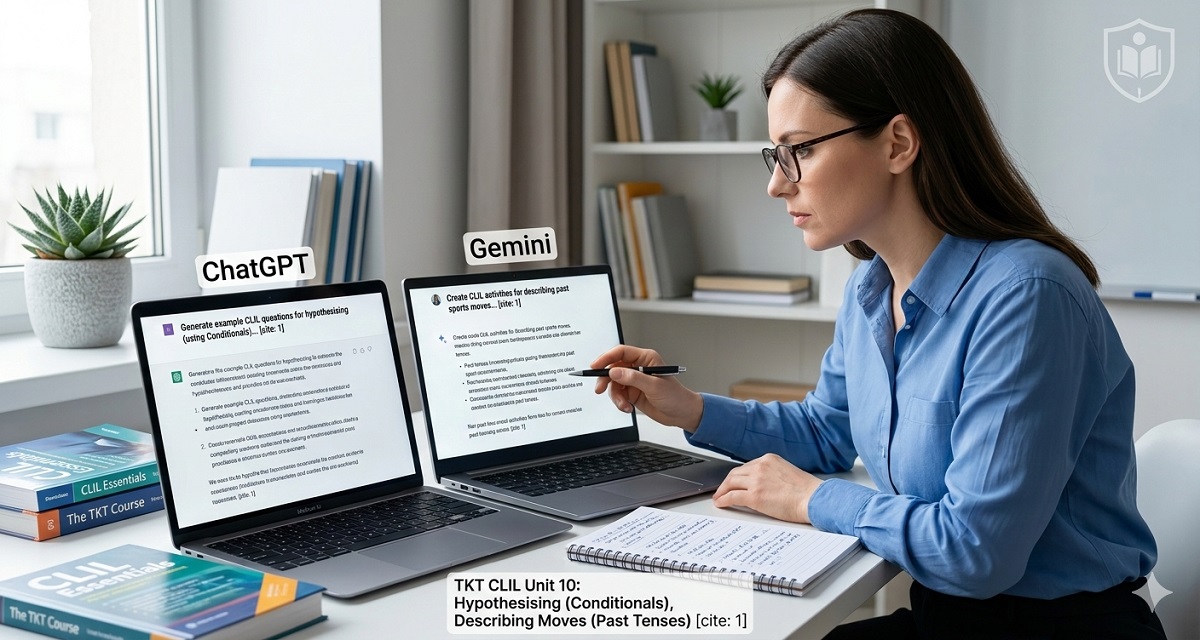
To answer this, we analysed responses from Gemini and ChatGPT for the same prompt about Unit 10 of the TKT CLIL syllabus.
Unit 10 focuses on classroom activity types and how they structure cognitive engagement in CLIL lessons.
Understanding these distinctions is critical because Cambridge exam questions often test subtle differences between activities, organisers, and cognitive processes.
What TKT CLIL Unit 10 Tests
Unit 10 primarily assesses understanding of activity types used in CLIL classrooms.
Candidates must recognize how different activities influence:
-
learner interaction
-
cognitive processing
-
collaboration
-
classification
-
reasoning
Typical exam tasks ask candidates to match an activity with its classroom aim or cognitive purpose.
Examples include:
-
Pyramid discussion
-
Binary key
-
Hot seat
-
Loop or domino activities
Gemini’s Approach to Unit 10
Gemini’s response focused strongly on cognitive processing and information transfer.
It highlighted concepts such as:
-
information transfer tasks
-
jigsaw activities
-
ranking and ordering
-
categorising
-
binary keys
Gemini also emphasized cognitive demand distinctions:
LOTS (Lower Order Thinking Skills)
-
matching
-
labeling
-
identifying
HOTS (Higher Order Thinking Skills)
-
analysing
-
evaluating
-
creating
This explanation aligns closely with CLIL pedagogy where cognition is central to lesson design.
However, Gemini sometimes focuses more on cognitive theory rather than the specific activity types that Cambridge frequently tests.
ChatGPT’s Approach to Unit 10
ChatGPT’s answer concentrated more directly on the exact activity types commonly appearing in TKT exam questions.
Key activity types highlighted included:
-
pyramid discussion
-
binary key
-
hot seat
-
loop activity
Each was defined using clear exam-safe definitions, which is particularly useful for multiple-choice preparation.
Example:
Binary key
An identification activity where learners classify items using a sequence of yes/no questions.
Hot seat
A role-based questioning activity where one learner answers questions from peers.
This approach mirrors the structure of many official TKT exam items, where candidates must select the activity that matches a teacher’s aim.
Key Differences Between Gemini and ChatGPT
| Feature | Gemini | ChatGPT |
|---|---|---|
| Focus | Cognitive theory | Exam activity types |
| Strength | Understanding cognition | Identifying activity types |
| Risk | Over-theoretical explanations | Less emphasis on broader CLIL frameworks |
| Best Use | Deep conceptual understanding | Exam preparation and practice |
For TKT candidates, both perspectives are valuable.
Gemini helps understand why activities support cognition, while ChatGPT focuses on how exam questions identify those activities.
Example TKT Exam Scenario
Teacher aim:
Students must identify an unknown plant species by answering yes/no questions.
Possible answers:
A. Tree diagram
B. Binary key
C. Mind map
D. Pyramid discussion
Correct answer:
Binary key
The task requires a structured sequence of yes/no classification decisions.
Common Unit 10 Exam Traps
Cambridge exam writers often include distractors that look similar.
Typical traps include:
Binary key vs tree diagram
Binary key = decision-making process
Tree diagram = visual organiser
Hot seat vs questioning
Hot seat = role-based peer questioning
Questioning = teacher strategy
Activity vs organiser
Activities involve interaction.
Organisers structure information visually.
Recognizing these distinctions is essential for success.
Which AI Tool Helps More for TKT CLIL?
The answer depends on the candidate’s goal.
For conceptual understanding of CLIL pedagogy:
Gemini provides deeper explanations.
For exam preparation and recognising question patterns:
ChatGPT provides clearer exam-aligned terminology and activity identification.
The most effective strategy is combining both approaches:
-
Gemini for theoretical insight
-
ChatGPT for exam practice
Final Thoughts
Artificial intelligence is becoming an important tool for teacher professional development.
However, success in Cambridge TKT CLIL exams still depends on understanding key distinctions between activity types, cognitive skills, and teaching strategies.
Used strategically, AI tools can help transform passive revision into interactive exam preparation.