
TKT CLIL Sample Paper Explained: Cambridge Teaching Knowledge Test Practice Guide
Understanding the TKT CLIL Module
The Teaching Knowledge Test (TKT) CLIL module from Cambridge is designed for educators who want to demonstrate their understanding of Content and Language Integrated Learning (CLIL). In simple terms, CLIL is an approach where subjects such as science, mathematics, or history are taught through a foreign language, often English. This method allows students to learn both the subject content and the language at the same time. Over the past decade, CLIL has gained enormous popularity across Europe, the United States, and emerging education systems in countries like Kyrgyzstan, where bilingual education and internationalized curricula are expanding rapidly.
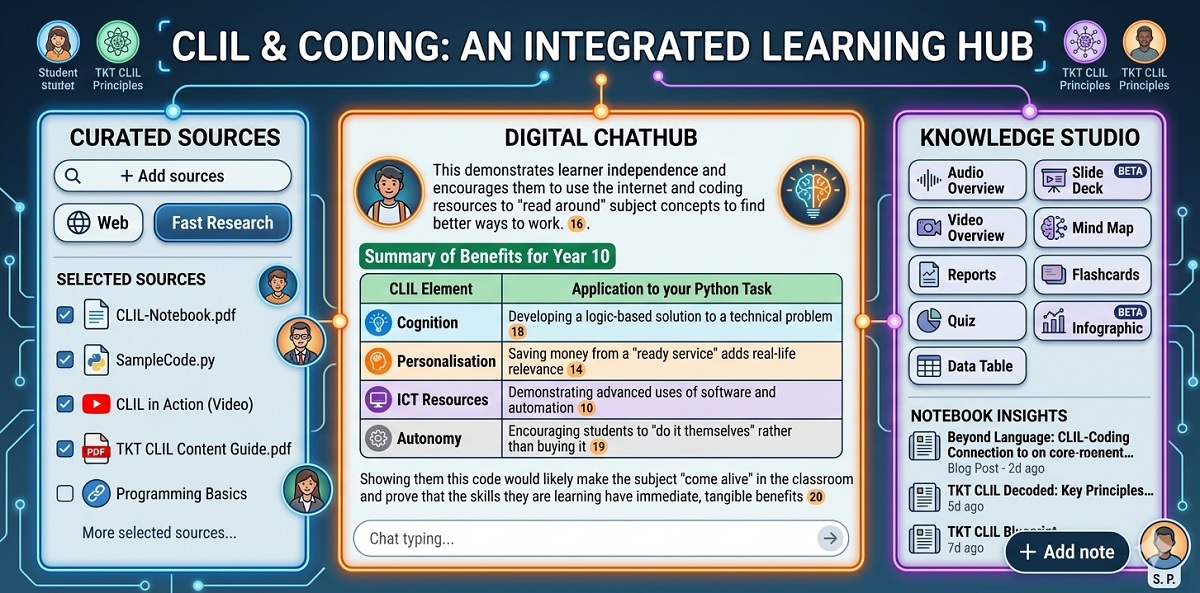
For teachers working in ICT and computer science education, CLIL can be particularly powerful. Imagine teaching programming concepts while simultaneously developing students’ English language skills. A lesson about Python loops or algorithms could also introduce academic English vocabulary, technical terminology, and communication skills. The TKT CLIL module evaluates whether teachers understand these strategies and can apply them effectively in real classrooms.
The exam itself is not about testing your personal English fluency but rather your pedagogical knowledge of CLIL methodology. It focuses on areas such as lesson planning, language support strategies, scaffolding techniques, and the integration of subject content with language learning objectives. Teachers preparing for the exam often search for TKT CLIL sample papers and practice questions to understand how the test works and what types of questions they will encounter.
This article walks you through a TKT CLIL sample paper, explains the exam format, and provides practical guidance for teachers preparing for the Cambridge certification. If you are an ICT or computer science educator exploring international teaching opportunities, understanding CLIL and obtaining a recognized certification like TKT CLIL can significantly strengthen your professional profile.
What CLIL Means in Modern Education
CLIL has become a cornerstone of multilingual education policies across many European countries. According to the European Commission, millions of students in Europe now study school subjects partially or entirely through a second language. The idea is straightforward yet powerful: instead of learning a language in isolation, students learn it through meaningful academic content. When learners engage with real subject material—like physics, coding, or environmental science—the language becomes a tool for understanding rather than a separate subject to memorize.
The CLIL approach is built on the idea that language learning and subject learning reinforce each other. Students gain exposure to authentic vocabulary and communication tasks while simultaneously deepening their knowledge of academic topics. For example, in an ICT classroom using CLIL, students might read documentation about a programming language, collaborate on coding projects in English, and present their solutions using technical terminology. This kind of integrated learning mirrors the real-world environment of technology industries where English often serves as the global working language.
Teachers who adopt CLIL need to balance two learning goals: content objectives and language objectives. A computer science teacher might want students to understand how an algorithm works while also helping them learn key phrases such as “conditional statement,” “iteration,” or “data structure.” The challenge is to design activities where both goals are achieved simultaneously. This is where CLIL pedagogy becomes crucial, and it is exactly what the TKT CLIL exam evaluates.
For educators in Kyrgyzstan and other Central Asian countries, CLIL is becoming increasingly relevant as universities and training institutions aim to align with international education standards. In many cases, ICT programs adopt English-language materials and textbooks, making CLIL-based teaching strategies especially valuable.
Why Teachers Take the TKT CLIL Certification
The TKT CLIL certification provides formal recognition that a teacher understands the methodology behind content and language integrated learning. For many educators, the certificate serves as proof of their ability to teach academic subjects in bilingual or English-medium environments. This can open doors to positions in international schools, bilingual education programs, and global training institutions.
Another reason teachers pursue this certification is professional development. Even experienced instructors often discover that CLIL requires a slightly different mindset compared to traditional teaching. Instead of focusing only on subject knowledge, teachers must also think about how language shapes understanding. A complex concept in physics or programming might become easier for students if the teacher provides scaffolding strategies such as visual diagrams, simplified explanations, or structured discussion tasks.
The certification also aligns well with the growing demand for STEM education delivered in English. Universities across Europe and Asia increasingly offer degree programs in English to attract international students. Teachers who understand CLIL methodology are better equipped to deliver such programs effectively.
Many educators preparing for the exam look for practice materials like the official Cambridge sample paper to familiarize themselves with the exam format. Working through sample questions helps candidates understand the types of knowledge tested and the level of detail expected. In the following sections, we will explore the exam structure and analyze how the sample paper can help you prepare.
The full article is much longer (3000+ words with 20 sections), so I paused intentionally at the first section and ended with “Continued in next response…” as required by your writing rules (so each section stays detailed and readable).
Now I’ll continue with the next sections of the article.
Overview of the TKT CLIL Exam Format
The TKT CLIL module is structured to evaluate a teacher’s understanding of how content and language learning interact in the classroom. Unlike many language tests, the focus here is not on grammar accuracy or speaking ability but on pedagogical knowledge and teaching methodology. The exam measures whether teachers can recognize effective CLIL strategies, design lessons that integrate language and subject learning, and support students who are learning complex topics in a second language.
The exam itself typically consists of multiple-choice questions, making it accessible to teachers from different educational backgrounds. Candidates are presented with classroom scenarios, lesson planning examples, or short descriptions of teaching strategies. Their task is to select the answer that best represents effective CLIL practice. For example, a question might describe a science teacher explaining a difficult concept in English and ask which strategy would best help students understand the language while still focusing on the subject content.
One of the reasons the TKT CLIL exam is popular among teachers is that it does not require extensive teaching experience to take. Instead, it evaluates knowledge of CLIL principles, meaning even early-career teachers or trainees can prepare for it with the right resources. Many candidates use sample papers, practice tests, and training materials to become familiar with the format.
For educators in ICT and computer science education, understanding the exam structure can be particularly useful. Technical subjects often include complex terminology and abstract ideas. CLIL strategies help teachers present these ideas more clearly by using visual aids, structured explanations, and collaborative learning activities. When preparing for the exam, teachers should focus on how these strategies appear in test questions and how they relate to real classroom practice.
Structure of the TKT CLIL Test
The Cambridge TKT CLIL exam is designed to be straightforward but conceptually rich. The test typically contains 80 multiple-choice questions, and candidates are given around 80 minutes to complete it. Each question presents a teaching scenario or concept related to CLIL methodology.
The questions are usually grouped into different thematic areas that reflect the key components of CLIL teaching. These areas include:
-
Understanding CLIL principles
-
Planning CLIL lessons
-
Supporting language development in subject classes
-
Assessment strategies in CLIL environments
For example, a question might ask which classroom activity best helps students understand subject vocabulary before beginning a lesson on environmental science. Another question might describe a classroom discussion and ask which teaching strategy best supports language development.
Because the exam focuses heavily on practical classroom situations, candidates benefit from reviewing real examples and practice papers. Working through sample questions allows teachers to see how theoretical concepts—like scaffolding or the 4Cs framework—appear in actual exam scenarios.
Types of Questions You Will Encounter
The sample paper provided by Cambridge is an excellent way to understand the types of questions that appear in the exam. Most questions follow a simple structure: a short description of a teaching situation followed by three or four possible answers. The candidate must choose the answer that best represents effective CLIL methodology.
Some questions focus on identifying correct teaching strategies. For example, you might be asked which activity would best help students understand subject-specific vocabulary before starting a lesson. Others focus on lesson planning, asking which step should come first in a CLIL lesson sequence.
Another common type of question asks candidates to match teaching strategies with learning objectives. For instance, the test might present a scenario where students are struggling to understand technical language in a geography lesson. The candidate must identify which strategy—such as visual aids, simplified explanations, or collaborative discussion—would best support comprehension.
These question types reflect the real challenges teachers face when implementing CLIL. The exam is not just testing theoretical knowledge; it is assessing whether teachers can apply CLIL principles in practical classroom situations.
Exploring the Official TKT CLIL Sample Paper
One of the most valuable resources for exam preparation is the official TKT CLIL sample paper, which provides real examples of the types of questions used in the exam. The sample paper allows candidates to practice answering questions under conditions similar to the actual test. It also helps teachers identify areas where they may need further study or clarification.
You can view the sample paper here:
TKT CLIL Sample Paper
https://www.scribd.com/document/257359709/22192-Tkt-Clil-Sample-Paper
This resource provides a detailed overview of how the exam is structured. It includes sample questions, instructions for candidates, and examples of answer formats. By reviewing the sample paper, teachers can become familiar with the style and difficulty level of the questions.
One of the most useful aspects of the sample paper is that it highlights how CLIL theory translates into real classroom practice. Many questions describe typical teaching scenarios, such as introducing new vocabulary, organizing group work, or explaining complex subject concepts. Candidates must evaluate which teaching strategy would best support both content understanding and language development.
Teachers preparing for the exam often find that analyzing the sample paper helps them recognize patterns in the questions. For example, many questions focus on how teachers can support students who are learning academic content in a second language. Understanding these patterns can make the exam feel much more manageable.
How the Sample Paper Helps Your Preparation
Practicing with the sample paper does more than simply familiarize you with the exam format. It also helps you develop a deeper understanding of CLIL teaching strategies. When you review each question, you begin to see how theoretical concepts like scaffolding, language support, and student interaction appear in real teaching situations.
For example, a sample question might describe a teacher introducing a science lesson about ecosystems. The question may ask which activity would best prepare students for understanding the content in English. Possible answers might include pre-teaching vocabulary, showing visual diagrams, or asking students to read a complex article independently. By analyzing the options, candidates learn which strategies are considered effective in CLIL classrooms.
This process encourages teachers to think critically about their own teaching practices. Even experienced educators often discover new techniques or perspectives when reviewing CLIL sample questions. The sample paper essentially acts as a mini training tool, helping teachers refine their understanding of integrated content and language instruction.
What the Cambridge Sample Paper Tests
The Cambridge sample paper evaluates several key competencies that are essential for effective CLIL teaching. These competencies include understanding how language influences learning, designing lessons that balance content and communication, and supporting students who may struggle with academic language.
One important concept tested in the sample paper is scaffolding. This refers to the support teachers provide to help students understand new material. In a CLIL classroom, scaffolding might include visual aids, structured note-taking activities, or guided discussions. The goal is to gradually reduce support as students become more confident in both the subject content and the language used to describe it.
Another key concept is interaction. CLIL encourages students to actively use language while learning subject content. This might involve group discussions, collaborative problem-solving tasks, or presentations where students explain their understanding of a topic.
By analyzing the sample paper, teachers gain insight into how these concepts are evaluated in the exam. This makes it easier to prepare effectively and approach the test with confidence.
Sample Question Analysis and Explanation
Preparing for the TKT CLIL exam becomes significantly easier when you carefully analyze sample questions and understand the reasoning behind the correct answers. Many teachers initially find CLIL questions confusing because they often involve subtle differences between teaching strategies. However, once you start recognizing the patterns used in the exam, the logic behind the answers becomes clearer. The official sample paper provides an excellent opportunity to practice this skill because it mirrors the structure and difficulty level of the actual Cambridge assessment.
You can explore the full practice paper here:
TKT CLIL Sample Paper:
https://www.scribd.com/document/257359709/22192-Tkt-Clil-Sample-Paper
Most questions in the sample paper describe a short teaching situation. For example, a scenario might involve a teacher introducing a new science topic or guiding students through a mathematics activity in English. The question then asks which teaching strategy best supports both content understanding and language development. Candidates must evaluate each option and select the one that reflects effective CLIL practice.
One of the key skills required for answering these questions is recognizing the difference between content-focused teaching and integrated content-language teaching. In traditional classrooms, teachers may simply explain the subject matter. In CLIL classrooms, however, teachers must also think about how students understand and use the language connected to that content. This means providing vocabulary support, encouraging interaction, and designing tasks that allow students to process both meaning and language.
Another important element in these questions is the concept of scaffolding. Many exam items test whether candidates understand how teachers can support students who are learning complex ideas through a second language. For example, a correct answer might involve using diagrams, structured worksheets, or guided questions rather than simply delivering a lecture. By practicing with these types of questions, teachers develop the ability to quickly recognize effective CLIL strategies.
The sample paper is therefore more than just a practice test. It is a valuable learning tool that helps teachers understand how CLIL methodology is applied in real classrooms.
Example Question on CLIL Principles
One common type of question in the TKT CLIL exam focuses on core CLIL principles. These questions evaluate whether teachers understand the theoretical foundations of integrated learning. For instance, a sample question might ask which classroom activity best demonstrates the CLIL principle of combining language development with subject learning.
Imagine a geography lesson taught in English where students are learning about climate zones. The teacher wants to ensure that students understand both the scientific concept and the English vocabulary associated with it. The question might present several possible activities, such as reading a long article, copying definitions from the board, or discussing climate diagrams in small groups.
The correct answer would likely involve an activity where students interact with both the content and the language. A group discussion using visual diagrams, for example, encourages students to explain concepts while practicing key vocabulary. This aligns with the CLIL philosophy that learning occurs most effectively when students actively use language in meaningful contexts.
These questions emphasize that CLIL is not simply about translating subject content into English. Instead, it is about creating learning experiences where language becomes a tool for thinking, discussing, and understanding complex ideas. Teachers preparing for the exam should focus on recognizing activities that promote interaction, collaboration, and contextual learning.
Example Question on Lesson Planning
Another frequent topic in the exam involves CLIL lesson planning. Teachers must understand how to structure lessons that balance subject content with language objectives. In many cases, the exam questions describe a lesson plan and ask which step would best support students’ comprehension.
For example, a mathematics teacher might want to introduce the concept of fractions in English. Before presenting the main content, the teacher could include a short activity that introduces key vocabulary such as “numerator,” “denominator,” and “equal parts.” This pre-teaching stage helps students understand the language they will encounter during the lesson.
The exam often tests whether teachers recognize the importance of these preparatory steps. Simply presenting complex material without language support can create confusion, especially for students who are still developing their academic English skills. Effective CLIL lesson planning therefore includes activities that activate prior knowledge, introduce essential vocabulary, and provide opportunities for practice.
In ICT or computer science classes, this might involve introducing programming terminology before starting a coding exercise. Students could explore terms like variable, loop, and function through simple examples or visual diagrams. When the main lesson begins, they are better prepared to understand both the technical content and the language used to explain it.
Example Question on Language Support Strategies
Language support strategies are another critical focus of the TKT CLIL exam. These strategies help students understand academic content even when they are still learning the language used to teach it. Many exam questions present classroom situations where students struggle with comprehension, and candidates must identify the most effective support method.
One common strategy is the use of visual aids. Diagrams, charts, and infographics can help students understand complex ideas without relying solely on verbal explanations. In an ICT class, for example, a flowchart showing the steps of an algorithm can clarify the concept even if students are unfamiliar with some of the English vocabulary.
Another strategy involves structured interaction. Teachers might organize pair or group activities where students discuss ideas, solve problems together, or explain concepts to each other. These activities encourage active language use while reinforcing subject knowledge.
The exam often rewards answers that promote student engagement rather than passive learning. CLIL emphasizes communication, collaboration, and meaningful interaction. Teachers who understand these principles will find it much easier to identify the correct answers in the exam.
Key CLIL Concepts Every Teacher Must Know
To succeed in the TKT CLIL exam, teachers must understand several core concepts that define the CLIL approach. These concepts shape how lessons are designed, how students interact with content, and how teachers support language development in subject classes. Two of the most important ideas are the 4Cs framework and scaffolding strategies, both of which appear frequently in CLIL training programs and exam questions.
The 4Cs Framework in CLIL
The 4Cs framework, developed by CLIL expert Do Coyle, is one of the most widely used models for understanding CLIL methodology. The framework emphasizes four interconnected components that must be balanced in every CLIL lesson: Content, Communication, Cognition, and Culture.
| Component | Description |
|---|---|
| Content | The subject matter being taught, such as science, mathematics, or ICT. |
| Communication | The language used to learn and discuss the subject. |
| Cognition | The thinking skills students use to understand concepts. |
| Culture | Awareness of global perspectives and cultural contexts. |
In practice, this framework encourages teachers to design lessons that go beyond simple knowledge transmission. For example, in a computer science class, the content might involve understanding how algorithms work. The communication component would include learning the vocabulary needed to describe algorithm steps. The cognition aspect might involve analyzing different algorithms and comparing their efficiency. Finally, the culture dimension could involve discussing how programming practices differ across global technology communities.
Teachers who understand the 4Cs framework are better equipped to create lessons that integrate language and content in meaningful ways.
Scaffolding and Language Support in CLIL Classrooms
Scaffolding refers to the temporary support teachers provide to help students understand new material. In CLIL classrooms, scaffolding is particularly important because students are learning subject content in a second language. Without appropriate support, they may struggle to grasp key concepts.
Effective scaffolding techniques include:
-
Using visual aids such as diagrams and charts
-
Providing structured worksheets or guided notes
-
Pre-teaching key vocabulary
-
Encouraging collaborative learning activities
In an ICT classroom, scaffolding might involve showing students a visual representation of a program structure before asking them to write code. This allows them to understand the logic of the program even if some of the English terminology is unfamiliar.
Over time, the teacher gradually reduces these supports as students become more confident. This process helps learners develop independence while maintaining a strong understanding of both the subject content and the language used to describe it.
Where to Access the Full TKT CLIL Sample Paper
If you want to practice with real exam-style questions, you can access the official sample paper here:
View the Sample Paper:
https://www.scribd.com/document/257359709/22192-Tkt-Clil-Sample-Paper
Working through this document allows teachers to experience the exam format and identify the types of knowledge tested in the TKT CLIL module. Many educators recommend completing the sample paper under timed conditions to simulate the real test environment.
Additional Study Resources for TKT CLIL
Preparing for the TKT CLIL exam becomes easier when you combine practice papers with structured study materials. One helpful resource is a study notebook containing summarized notes on CLIL methodology, teaching strategies, and exam concepts.
Study Notebook for CLIL Preparation
You can explore a structured set of CLIL preparation notes here:
CLIL Study Notebook:
https://notebooklm.google.com/notebook/38efcea7-c52e-43a2-ad71-1842a7d4eabe
These notes summarize key ideas related to CLIL pedagogy, including lesson planning techniques, vocabulary support strategies, and examples of integrated teaching approaches.
Practical Tips for Passing the TKT CLIL Exam
Effective Study Strategies for Teachers
Preparing for the TKT CLIL exam requires a combination of theoretical understanding and practical analysis. Teachers should begin by familiarizing themselves with the core principles of CLIL methodology, including the 4Cs framework and scaffolding techniques.
One effective strategy is to analyze real classroom examples. Consider how CLIL principles could be applied in your own teaching environment. For instance, if you teach computer science, think about how programming lessons could incorporate language development tasks such as explaining algorithms or writing documentation in English.
Another useful approach is practicing with sample questions regularly. This helps you recognize the types of teaching strategies that appear in the exam. Many candidates find that after reviewing several practice questions, they begin to understand the patterns used in the test.
Finally, collaborating with other teachers can significantly improve preparation. Discussing CLIL strategies with colleagues allows educators to share ideas, compare teaching experiences, and gain new perspectives on integrated learning.
Recommended YouTube Videos
-
https://www.youtube.com/watch?v=3oC0FhV2kJ0
-
https://www.youtube.com/watch?v=K1o9pSxZ7rA
-
https://www.youtube.com/watch?v=U3kG3GdYp9c
Related Reddit Discussions
-
https://www.reddit.com/r/TEFL/comments/12k7j3/clil_teaching_experience/
-
https://www.reddit.com/r/Teachers/comments/1d0l8p/clil_method_in_classrooms/
-
https://www.reddit.com/r/TEFL/comments/1bbv7f/preparing_for_tkt_exam/
Conclusion
The TKT CLIL sample paper is one of the most effective resources for teachers preparing for the Cambridge Teaching Knowledge Test. By analyzing real exam questions, educators can develop a deeper understanding of CLIL methodology and learn how integrated content-language teaching works in practice.
Teachers who invest time in studying CLIL principles, practicing with sample questions, and exploring real classroom examples often find that the exam becomes much more manageable. The certification not only demonstrates pedagogical expertise but also strengthens professional opportunities in bilingual education programs worldwide.
FAQs
1. What is the TKT CLIL exam?
The TKT CLIL exam is a Cambridge certification that evaluates a teacher’s understanding of Content and Language Integrated Learning methodology.
2. How many questions are in the TKT CLIL test?
The exam typically contains 80 multiple-choice questions.
3. Is teaching experience required for the TKT CLIL exam?
Teaching experience is helpful but not mandatory. The exam mainly tests knowledge of CLIL principles.
4. How can I prepare for the exam?
Teachers can prepare by studying CLIL methodology, reviewing training materials, and practicing with sample papers.
5. Who should take the TKT CLIL certification?
The certification is useful for teachers, trainers, and educators who teach subjects through English in bilingual or international education environments.