Smart Health: AI-Powered Remote Monitoring System for Diabetic and Heart Patients
Smart Health: AI-Powered Monitoring for Diabetic and Heart Patients
The Healthcare Challenge
Millions of people worldwide suffer from chronic diseases such as diabetes and cardiovascular conditions. These diseases require continuous monitoring to prevent severe complications such as heart attacks, strokes, and diabetic emergencies.
In many developing countries, access to healthcare remains limited due to high costs, lack of medical infrastructure, or geographical barriers.
Smart Health was designed to address these challenges by creating a technology-driven remote healthcare monitoring system capable of supporting patients directly from their homes.
The goal was to use artificial intelligence, connected medical devices, and cloud computing to detect health risks early and provide preventive care.
Why We Created Smart Health
Smart Health was developed to address critical healthcare challenges faced by millions of diabetic and heart patients worldwide.
Many patients struggle with:
-
limited access to doctors
-
high healthcare costs
-
delayed diagnosis
-
lack of continuous monitoring
Diabetes alone affects hundreds of millions of people globally and remains one of the leading causes of preventable death.
The mission of the Smart Health project was to provide accessible life-saving healthcare technology that could help detect medical risks earlier and reduce complications.
Project Aim
The Smart Health system was designed to combine multiple technologies into a single platform:
-
Artificial Intelligence
-
Real-time health monitoring
-
Cloud-based medical data systems
-
Connected healthcare devices
The objective was to empower:
-
patients
-
family members
-
healthcare professionals
By providing early detection and predictive analytics, Smart Health aimed to reduce emergency hospital visits and improve patient quality of life.
Smart Check: The Medical Monitoring Device
At the center of the project was the Smart Check device, a compact medical monitoring unit capable of measuring several important health indicators.
The device was designed to measure:
-
Blood pressure
-
Glucose level
-
Pulse rate
-
Electrocardiogram (ECG)
-
Body temperature
-
Oxygen saturation (SpO₂)
-
Sleep apnea
-
Physical activity metrics (steps, calories burned)
These measurements were transmitted to the Smart Health platform for analysis.
The device also functioned similarly to a portable ICU monitoring system, continuously tracking key vital signs such as heart rate and oxygen levels.
Artificial Intelligence Health Prediction
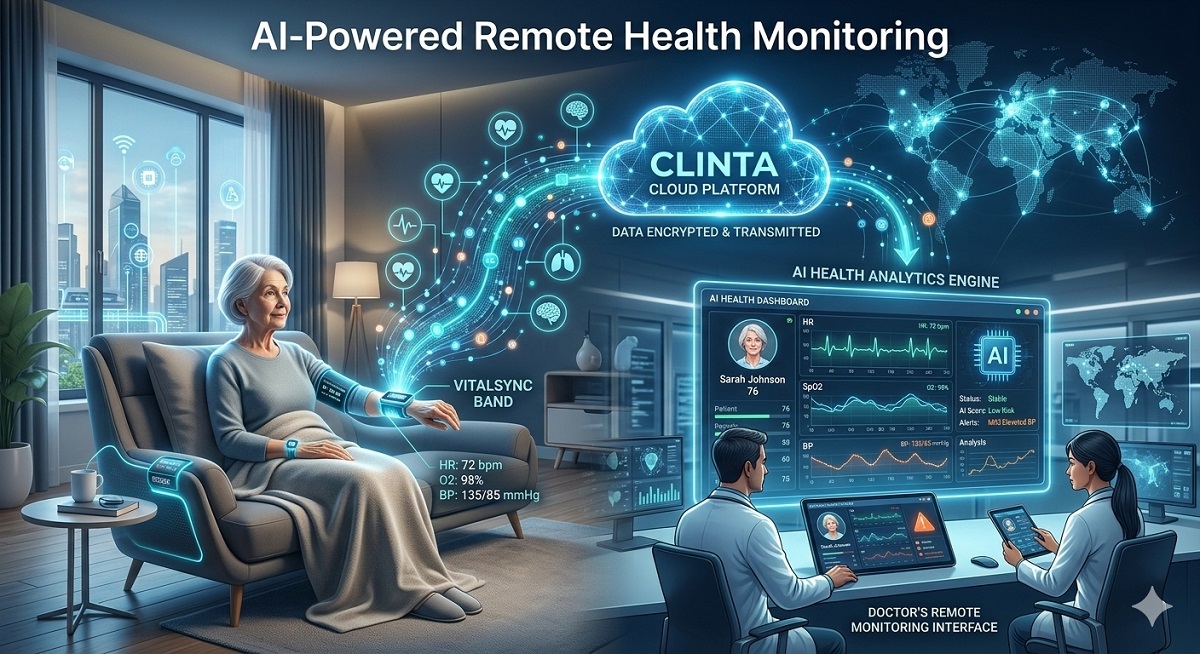
One of the most innovative components of Smart Health was its AI-based prediction system.
The AI software analyzed patient health data collected from the Smart Check device.
The system could:
-
identify high-risk patients
-
detect abnormal health patterns
-
predict potential medical emergencies
-
provide early alerts
For example, the AI model could estimate risk of cardiac arrest based on patient age, vital signs, and historical health data.
This predictive capability aimed to shift healthcare from reactive treatment to preventive care.
Mobile Application and Doctor Suite
The Smart Health platform included a mobile application designed for patients, guardians, and healthcare professionals.
The mobile app allowed:
-
real-time monitoring of vital signs
-
automatic data synchronization with the cloud
-
diabetes diary for food intake tracking
-
insulin dosage suggestions
Healthcare providers could monitor patient data through a secure web dashboard connected to the cloud infrastructure.
This system enabled remote healthcare supervision and faster medical decision making.
The Patient Monitoring Cycle
The Smart Health monitoring workflow followed several steps.
-
Patients measure vital signs using the Smart Check device.
-
Data is transferred via Bluetooth to the mobile application.
-
The mobile app uploads the data to a cloud server.
-
Guardians and clinicians monitor health data through dashboards.
-
When abnormal values are detected, the system alerts the medical team.
-
Clinicians contact patients to provide advice or schedule doctor appointments.
Patients could also grant their doctors access to historical medical records and laboratory test results.
Funding Challenges and Project Closure
To operate effectively, Smart Health required funding for several essential components:
-
cloud hosting infrastructure
-
mobile app development
-
device support and maintenance
-
a 24/7 clinical monitoring team
Crowdfunding campaigns were launched with an initial goal of $5,500, later expanding to $19,200.
Unfortunately, the project was unable to secure the required funding, which forced the shutdown of operations.
Why We Open-Sourced the Smart Health Project
Although the project could not continue due to financial constraints, the vision behind Smart Health remains important.
The decision was made to open-source the project so that developers, researchers, and healthcare organizations can build upon the work.
The repository includes:
-
software documentation
-
system architecture
-
research notes
-
project presentations
-
financial planning documents
By sharing the technology publicly, the goal is to enable others to continue developing tools that improve healthcare accessibility.
The Role of Technology in Modern Healthcare
Projects like Smart Health demonstrate how computer science and engineering can significantly impact healthcare.
Technologies involved in this system include:
-
Artificial Intelligence
-
Internet of Things (IoT)
-
Cloud computing
-
Mobile application development
-
Healthcare data analytics
For students studying computer science, projects like Smart Health illustrate how technology can solve real-world problems and improve lives.
Conclusion
Smart Health was designed as a technology-driven healthcare monitoring system that could help diabetic and heart patients manage their health more effectively.
Although the project ended due to funding limitations, its open-source release allows developers and healthcare innovators to continue exploring solutions that improve healthcare accessibility.
With advances in AI and connected medical devices, the future of healthcare monitoring will likely become more intelligent, predictive, and accessible to patients worldwide.
Related Videos
AI in Healthcare Explained
https://www.youtube.com/watch?v=qDTJc4wG6tU
How Remote Patient Monitoring Works
https://www.youtube.com/watch?v=8uJ6Xk7zF9M
Internet of Things in Healthcare
https://www.youtube.com/watch?v=F_2GgK0J0hE
Related Reddit Discussions
Discussion about AI in healthcare
https://www.reddit.com/r/technology/comments/ai_healthcare/
Discussion about wearable medical devices
https://www.reddit.com/r/Futurology/comments/health_wearables/
External Sources
World Health Organization – Digital Health
https://www.who.int/health-topics/digital-health
NIH – Remote Patient Monitoring
https://www.nih.gov
Author BIO
Ahmed Elmalla is an ICT and Computer Science educator with over 19 years of experience in software engineering and international teaching. He teaches Cambridge IGCSE, A-Level, and AP Computer Science, helping students build strong foundations in programming, computational thinking, and digital skills.
He has also worked on technology projects involving AI systems, cloud platforms, and connected devices, exploring how computer science can improve real-world industries such as healthcare.
LinkedIn:
https://www.linkedin.com/in/akelmalla
WhatsApp:
https://wa.me/60194028484