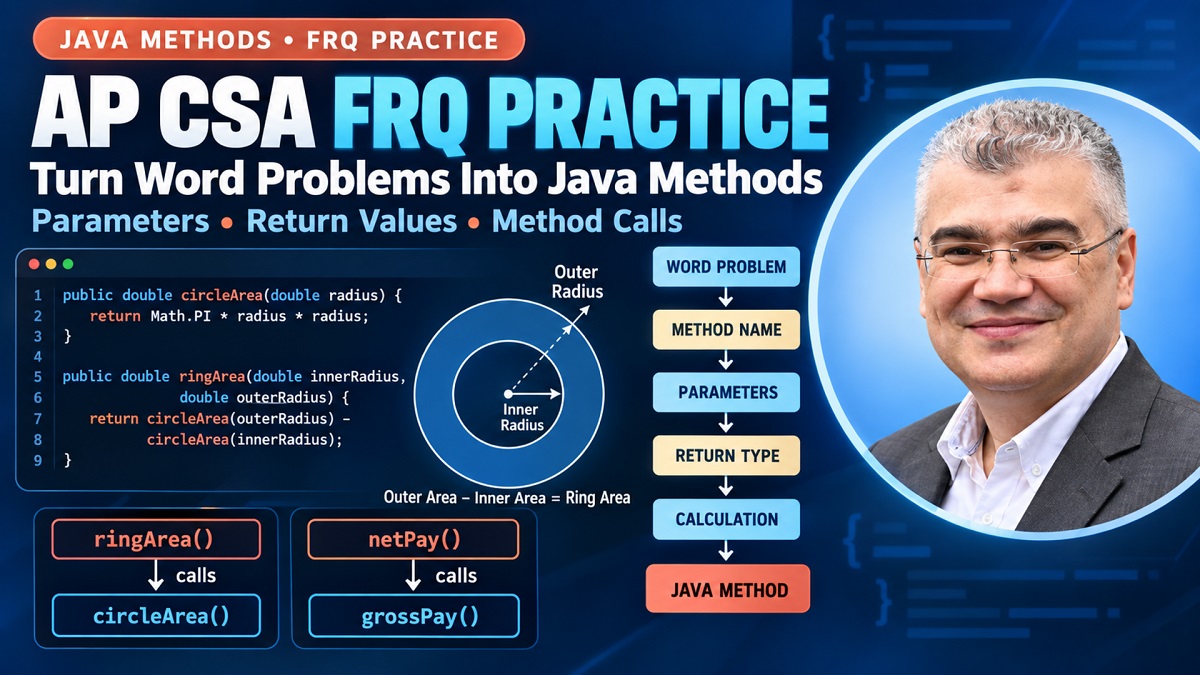
AP CSA FRQ Practice: How to Write Java Methods from Word Problems | Waddy Class 23
There's a frustrating stage in learning Java where you can look at a piece of code and understand what it does, yet a blank sheet of paper feels like an entirely different subject. Someone gives you a paragraph describing a method, and suddenly you're wondering where to begin. Should you write void or double? Which words become parameters? Do you need another variable? Should the calculation go directly inside return? And if the problem says you must call another method, where exactly does that call belong? This gap between reading Java and independently writing Java is one of the central problems addressed in this lesson.
The tutoring session behind this guide starts with exactly that difficulty. The student explains that longer, wordier method questions become confusing, even when the underlying programming concepts aren't necessarily unfamiliar. Later, the student makes the distinction even clearer: code-reading and “what will this print?” questions can be manageable, but handwriting the code independently is where the confusion appears. That observation shapes the entire lesson.
So instead of memorizing four finished Java methods, we're going to focus on a process you can reuse. The examples move from a simple circleArea method to a ringArea method that reuses it, and then from grossPay to the more complicated netPay. The names and calculations change, but the strategy doesn't: extract the requirements, construct the method, solve the smaller pieces, and connect them together.
📚 AP CSA Lesson Slides & Practice Resources
Want to practice the Java concepts from this lesson yourself? Use the supporting AP Computer Science A lesson slides and practice resources to review how to turn written programming requirements into complete Java methods. The slides reinforce the key ideas covered in this guide, including method headers, parameters, arguments, return types, Math.PI, calling one method from another, circleArea, ringArea, grossPay, netPay, and breaking longer FRQ-style questions into smaller programming steps. After reviewing the slides, try writing the methods independently on paper before checking your code—especially if you find that reading Java is easier than writing it from scratch.
📘 View / Download the AP CSA Lesson Slides →
Why Writing Java FRQs Feels Harder Than Reading Code
Reading code gives your brain clues everywhere. The variables already have names. Parentheses show you where the parameters are. Curly braces reveal where the method begins and ends. A return statement tells you that the method produces a value. When you're asked to predict an output, much of the architecture already exists; you're following a trail somebody else created.
Writing code reverses the process. Now you're responsible for building the trail.
That's why a student can correctly answer many code-tracing questions and still struggle when an assessment says something like, “Write a method named ringArea that takes two double parameters…” The programming isn't necessarily beyond the student's level. The challenge is converting natural language into a precise Java structure.
This is visible throughout the session. The student says that when a question becomes “too wordy,” translating it into a method becomes difficult. The student also mentions accidentally writing a data type such as double but forgetting the variable name while handwriting a solution. The lesson responds by emphasizing that a variable needs both a type and a name.
The fix isn't to rush through more syntax. It's to create a repeatable translation process. If the paragraph feels overwhelming, don't solve the whole paragraph. Pull it apart.
Stop Coding First—Extract the Requirements
One of the best habits demonstrated in the session is surprisingly simple: don't immediately start coding.
Read the question and extract information from it.
For the first circle problem, the lesson identifies the method name, parameter, parameter type, return behavior, and required calculation before assembling the method.
That turns a paragraph into a checklist.
Instead of seeing:
“Here is a long programming question and somehow I need to produce Java…”
you start seeing:
Method name: circleArea
Parameter: radius
Parameter type: double
Return type: double
Process: calculate the circle's area
Once you've extracted those pieces, the question becomes much smaller.
The Five Things to Find in a Method Question
When practicing method-based Java questions, train yourself to find five things before writing the body:
1. Method name. What exactly should this method be called?
2. Parameters. What information comes into the method?
3. Parameter types and order. Is each parameter an int, double, String, or another type, and does the prompt specify an order?
4. Return type. Does the method return a value? If so, what type should that value be?
5. Required process. What calculation or action must happen, and does the prompt require you to call another method?
The fifth item becomes particularly important in the ringArea exercise because the prompt requires the solution to call circleArea twice instead of simply rewriting the circle-area calculation.
Building a Java Method Header from English
Once you've extracted the requirements, build the shell before worrying about the details.
For example, if we've identified a method called circleArea, a double return type and one double parameter named radius, the basic structure becomes:
public double circleArea(double radius)
{
    // calculation goes here
}
The lesson carefully builds this structure from the wording of the problem. It identifies that the method shouldn't be void because a value needs to be returned, and it uses double for the return value. It then places the double radius parameter inside the parentheses and adds the curly braces for the method body.
This is valuable because you don't have to solve the calculation and remember the Java syntax simultaneously.
Build the container first.
Then fill it.
If you're practicing in an environment where your surrounding class design requires static, your method might instead be written with public static double. The transcript itself discusses both public double and public static double in the context of the exercises. The important lesson here is to follow the requirements and surrounding code you're actually given rather than mechanically attaching modifiers without understanding why they're there.
Understanding Parameters, Arguments and Return Types
Parameters describe what information a method expects to receive.
Suppose we have:
public double grossPay(double hourlyRate, double hoursWorked)
The method has two parameters. Both are double values. One represents an hourly rate and the other represents hours worked.
Now suppose somewhere else we call:
grossPay(10.0, 5.0)
The call supplies actual values.
The transcript explains this by showing that a value passed in the first position becomes associated with the first parameter and a value passed in the second position becomes associated with the second parameter. The student is guided through how Java effectively makes those values available through the parameter variables inside the method.
Why Parameter Order Matters
Consider:
grossPay(10.0, 5.0)
If the method header says:
grossPay(double hourlyRate, double hoursWorked)
then 10.0 corresponds to hourlyRate and 5.0 corresponds to hoursWorked.
That positional relationship is why reading “in that order” in a question matters.
Don't treat parameter order as decoration. It's part of the method's contract.
This becomes even more important when parameters share the same type. Java won't look at two double values and magically decide which one you intended to represent which concept. Your argument positions need to correspond to the method's parameter positions.
Example 1—Writing the circleArea Method
The first major example is intentionally manageable.
The method receives one double radius and returns the area of the circle. The lesson breaks the task into the method structure and the actual calculation rather than trying to write everything at once.
A clear version looks like:
public double circleArea(double radius)
{
    double area = Math.PI * radius * radius;
    return area;
}
Notice that area has two pieces when it is declared:
double area
double is the type.
area is the variable name.
That's important because one of the student's handwriting mistakes was remembering the data type but forgetting the variable identifier.
Using Math.PI Instead of Hard-Coding Pi
The lesson also discusses using Java's Math.PI rather than manually inserting a value such as 3.14.
That produces:
Math.PI * radius * radius
The larger lesson isn't just about circles. It's about recognizing when Java already provides something useful and following the requirements of the problem rather than replacing them with your own approximation.
Once area has been calculated, the method returns it:
return area;
Now we have a small reusable method. And that matters because the next problem doesn't want us to start over.
Example 2—Building ringArea from circleArea
Now the problem becomes more interesting.
The ringArea method receives two double parameters: an inner radius and an outer radius. The desired result is the area of the ring between the two circles. Crucially, the transcript's exercise says the method must call circleArea twice, once for each radius, rather than recomputing the area formula directly.
Visualize two circles sharing the same center.
The larger circle has the outer radius.
The smaller circle has the inner radius.
If you calculate the entire outer circle and then remove the area occupied by the inner circle, what's left?
The ring.
Mathematically:
ring area = outer circle area − inner circle area
Why ringArea Should Call circleArea Twice
Because circleArea already knows how to calculate a circle's area, ringArea can delegate both circle calculations to it.
One concise approach is:
public double ringArea(double innerRadius, double outerRadius)
{
    return circleArea(outerRadius) - circleArea(innerRadius);
}
The transcript spends considerable time making this flow concrete. First circleArea(outerRadius) produces one returned value. Then circleArea(innerRadius) produces another. Once both results exist, they can be subtracted to produce the ring area.
That's method reuse.
And it's one of the most transferable ideas in the lesson.
Returning an Expression vs Creating Variables
There's more than one readable way to express the ring-area logic.
The compact version is:
return circleArea(outerRadius) - circleArea(innerRadius);
But the lesson also demonstrates a more explicit step-by-step approach:
double outerArea = circleArea(outerRadius);
double innerArea = circleArea(innerRadius);
double ringArea = outerArea - innerArea;
return ringArea;
Conceptually, these approaches perform the same sequence.
Which should you use?
When learning, use the version you can reliably reason about. The transcript specifically explores this because the student finds creating multiple intermediate variables somewhat confusing and prefers the direct return expression.
Don't shorten code merely because short code looks advanced. And don't add variables merely because longer code looks safer.
Your goal is to write a correct solution you understand.
Example 3—Writing the grossPay Method
The next example changes the story but keeps the method-writing strategy.
The method is called grossPay.
It receives two double parameters: hourly rate and hours worked.
It returns gross pay before tax as a double.
Again, extract the structure before calculating anything.
Then ask what gross pay actually means.
If someone earns a certain amount per hour and works a certain number of hours, the calculation is:
hourly rate × hours worked
That can produce a compact method:
public double grossPay(double hourlyRate, double hoursWorked)
{
    return hourlyRate * hoursWorked;
}
Notice how much easier this becomes after separating the prompt into method name, parameters, return type and process.
A wordy question becomes a small sequence of decisions.
Example 4—Building netPay from grossPay
Now the same pattern from circleArea and ringArea appears again.
A smaller method exists: grossPay.
A larger method needs that result: netPay.
According to the transcript, netPay receives hourly rate, hours worked and a tax percentage. The exercise requires the method to call grossPay to obtain the pay before tax.
That's the important architectural relationship:
ringArea uses circleArea.
netPay uses grossPay.
Once you see that connection, the two exercises aren't really separate programming ideas. They're repetitions of the same idea in different contexts.
Converting a Tax Percentage into a Calculation
The tax part introduces another layer because the percentage can vary.
If you simply hard-code a multiplier that works for one particular tax rate, your method won't necessarily work for another tax rate. The percentage therefore needs to participate in the calculation as data.
A clear approach is to obtain the gross pay first, calculate the tax amount, and subtract it:
double gross = grossPay(hourlyRate, hoursWorked);
double tax = gross * (taxPercent / 100.0);
return gross - tax;
The key idea is that grossPay remains responsible for calculating gross pay, while netPay builds on that result.
That's decomposition in action.
How Java Passes Arguments into Parameters
This topic deserves special attention because it can initially feel as if values magically appear inside a method.
Imagine:
grossPay(10.0, 5.0)
and:
public double grossPay(double hourlyRate, double hoursWorked)
When that method executes, the first supplied value corresponds to hourlyRate and the second corresponds to hoursWorked. The transcript spends time walking through this process because understanding it makes later method calls much easier.
You don't rewrite:
double hourlyRate = 10.0;
inside the method every time someone calls it with 10.0.
The parameter is how the method receives the information.
Think of parameters as labeled slots in a machine. The method definition establishes the slots. The method call supplies the values that go into them.
Once those values are available through the parameter names, the method body can use those names in expressions.
Common Mistakes When Handwriting Java Methods
Handwriting code removes some of the feedback you're accustomed to getting from an IDE. There's no red underline instantly reminding you that a variable name is missing. That's why a deliberate structure matters.
The transcript highlights several useful mistakes to watch for. One is writing a data type such as double without supplying a variable name. Another is becoming uncertain about which intermediate variable should eventually be returned. The student also describes being much more comfortable reading code than constructing the same kind of code independently.
Before finishing a handwritten method, scan it.
Does the method have the requested name?
Are all parameters present?
Are they in the correct order?
Does every variable declaration contain both a type and a name?
If the method is non-void, does it return an appropriate value?
If the question says “must call” another method, did you actually call it?
That final check can catch a surprising number of errors.
A Repeatable AP CSA FRQ Method-Writing Strategy
Here's the process I would practice until it becomes automatic.
Read the entire prompt once without coding.
On the second read, extract the method name, return type, parameters and special requirements.
Write the method header.
Open the method body.
If another method must be called, identify what arguments it needs and what value its call will produce.
Work out the remaining calculation.
Then write the return statement.
Finally, reread the original question—not your code—and compare each requirement against what you wrote.
The tutoring session explicitly practices reading a problem, extracting information, and only then writing the method.
That's a much stronger strategy than staring at the whole paragraph and hoping the complete Java solution appears in your head.
Practice the Lesson with Slides and Homework
Reading through worked examples helps, but AP CSA programming improves fastest when you write the code yourself. I've prepared supporting lesson resources so you can review the concepts from this guide and then practice them independently. Use the lesson slides to revisit Java methods, parameters, return types, method calls, Math.PI, circleArea, ringArea, grossPay, netPay, and the step-by-step process for translating word problems into Java. After reviewing the slides, try the homework or practice exercises without copying the examples above. When you get stuck, return to the five-question method checklist rather than immediately looking for the finished solution.
📘 View / Download the AP CSA Lesson Slides →
📝 Download the AP CSA Practice / Homework →
🎥 Watch the Full AP CSA Tutoring Session →
Conclusion
The most important skill in this lesson isn't calculating a circle's area or somebody's gross pay. It's learning how to translate requirements into code.
circleArea teaches you to extract a method name, parameter and return type.
ringArea adds method reuse.
grossPay reinforces parameters and returned calculations.
netPay shows how a larger method can use the result of a smaller method while adding new logic.
When a programming question feels too wordy, don't attempt to hold the whole solution in your head. Pull out the pieces first.
Method name. Parameters. Types. Return type. Required calls. Calculation. Return value.
Then write the code.
AP CSA Java Method FAQs
1. How do I start a wordy Java method question?
Don't start with the calculation. First identify the method name, return type, parameters, parameter types, and any special instructions such as a requirement to call another method.
2. What is the difference between a parameter and an argument?
A parameter is declared in the method definition. An argument is a value or expression supplied when that method is called.
3. Can I put a calculation directly inside a return statement?
Yes, when the expression produces the value your method needs to return. For example, the lesson discusses directly returning calculations rather than always creating an intermediate variable.
4. Why would ringArea call circleArea twice?
The exercise requires the existing circle-area method to calculate the areas associated with the outer and inner radii. Those returned values can then be subtracted to obtain the ring area.
5. How can I improve at handwriting Java methods?
Practice writing methods from the prompt alone rather than repeatedly reading completed solutions. Extract the method requirements first, write the header, build the calculation one step at a time, and check your final code against every requirement in the original question.
Author Bio
Ahmed Elmalla is a Computer Science educator, Certified Cambridge International AS & A Level Computer Science (9618) teacher, and software engineer with over 20 years of teaching, software engineering, and international tutoring experience. He specializes in AP Computer Science A (Java) and Cambridge IGCSE (0478) and AS & A Level Computer Science (9618), helping students build strong programming, computational thinking, and exam-solving skills. Through his Learn with Kemo platform, he has mentored students from around the world using practical, exam-focused instruction tailored to each learner's needs. His lessons combine real-world software engineering experience with personalized one-to-one tutoring, making complex Java and Computer Science concepts easier to understand. Ahmed is passionate about helping students gain confidence, improve academic performance, and achieve outstanding results in international Computer Science examinations.
LinkedIn: https://www.linkedin.com/in/akelmalla
WhatsApp: https://wa.me/60194028484
1.png)
.png)
.png)