Java Method Calls & String Immutability Explained | AP Computer Science A Tutorial
Java Method Calls, Return Statements, and String Immutability Explained for AP Computer Science A
One of the biggest transitions students make in AP Computer Science A (AP CSA) is moving from writing simple Java statements to thinking like software developers. Concepts such as method definitions, method calls, return statements, and String immutability are introduced early, yet they continue to appear throughout the course and on the AP CSA exam.
During a recent one-to-one tutoring session, my student Waddy worked through these exact concepts while solving practical programming problems. Rather than memorizing syntax, we focused on understanding why Java works the way it does. By breaking complex problems into smaller methods and discussing how Strings behave differently from primitive data types, the lesson helped strengthen both programming confidence and problem-solving skills.
If you're preparing for the AP Computer Science A exam, mastering these concepts will make later topics such as classes, inheritance, ArrayLists, recursion, and free-response questions much easier.
Why Java Methods Are So Important
Methods are one of the foundations of object-oriented programming. Instead of writing the same code repeatedly, programmers write a method once and reuse it whenever needed.
Think of a method as a reusable tool.
For example, imagine calculating the distance between two points on a graph. Instead of placing the entire formula inside one long statement, you can divide the work into several smaller methods.
For example:
- calculate the difference between two numbers
- square a number
- calculate the total distance
- print the final answer
Breaking a problem into smaller pieces makes programs easier to read, debug, and maintain.
During our tutoring session, we used this exact strategy while implementing the distance formula.
Method Definition vs Method Call
One of the most common AP CSA misconceptions is confusing a method definition with a method call.
A method definition describes how a method works.
public static double square(double number){
    return number * number;
}
Nothing happens simply because the method exists.
To execute the code, another part of the program must call it.
double answer = square(5);
This tells Java:
"Run the instructions inside the method using the value 5."
Many students understand how to write methods but forget that defining a method does not automatically execute it. During the tutoring session, this became much clearer after tracing the execution flow step by step.
Passing Parameters into Methods
Methods become much more useful when they can work with different data.
Instead of creating separate methods such as:
squareFive()

squareTen()

squareTwenty()
we create one reusable method.
public static double square(double number){
    return number * number;
}
Now Java can calculate any square value.
square(5);

square(10);

square(18.7);
The parameter acts like a temporary variable that receives the value supplied by the caller.
Understanding parameters is essential because almost every AP CSA free-response question involves passing information between methods.
Why Return Statements Matter
Another important concept we discussed was the return statement.
A return statement sends information back to the code that called the method.
For example:
public static double average(double a, double b){
    return (a + b) / 2;
}
The returned value can then be stored.
double result = average(70, 90);
or printed immediately.
System.out.println(average(70,90));
Without a return statement, Java has nothing to send back.
During the lesson, Waddy initially omitted the return statement from one method, resulting in a compilation error. This became an excellent learning opportunity because it demonstrated why Java requires methods with return types to always return a value.
Solving the Distance Formula Using Multiple Methods
Rather than solving the entire distance formula inside one complicated expression, we divided it into smaller reusable methods.
Instead of writing one long calculation, we created methods that:
- calculate the difference between two numbers
- square a value
- calculate the final distance
This approach offers several advantages.
| Benefit | Explanation |
|---|---|
| Easier debugging | Smaller methods are easier to test individually. |
| Better readability | Each method performs one specific task. |
| Reusable code | The same method can be called from many different programs. |
| AP CSA best practice | Demonstrates decomposition and computational thinking. |
Breaking larger problems into smaller tasks is a skill frequently rewarded in the AP Computer Science A free-response questions.
Common Mistakes When Calling Methods
During tutoring, several mistakes appeared that are very common among AP CSA students.
Forgetting parentheses
Incorrect
distance;
Correct
distance(x1, y1, x2, y2);
Passing the wrong number of parameters
If a method expects four parameters, Java requires exactly four.
Forgetting to store the returned value
Incorrect
distance(x1,y1,x2,y2);
Correct
double answer = distance(x1,y1,x2,y2);
or
System.out.println(distance(x1,y1,x2,y2));
These mistakes appear frequently in classroom assessments and AP-style programming questions.
Understanding Java String Immutability
The second half of the tutoring session focused on one of Java's most misunderstood concepts: String immutability.
Unlike primitive variables such as:
int number = 10;
Strings are objects.
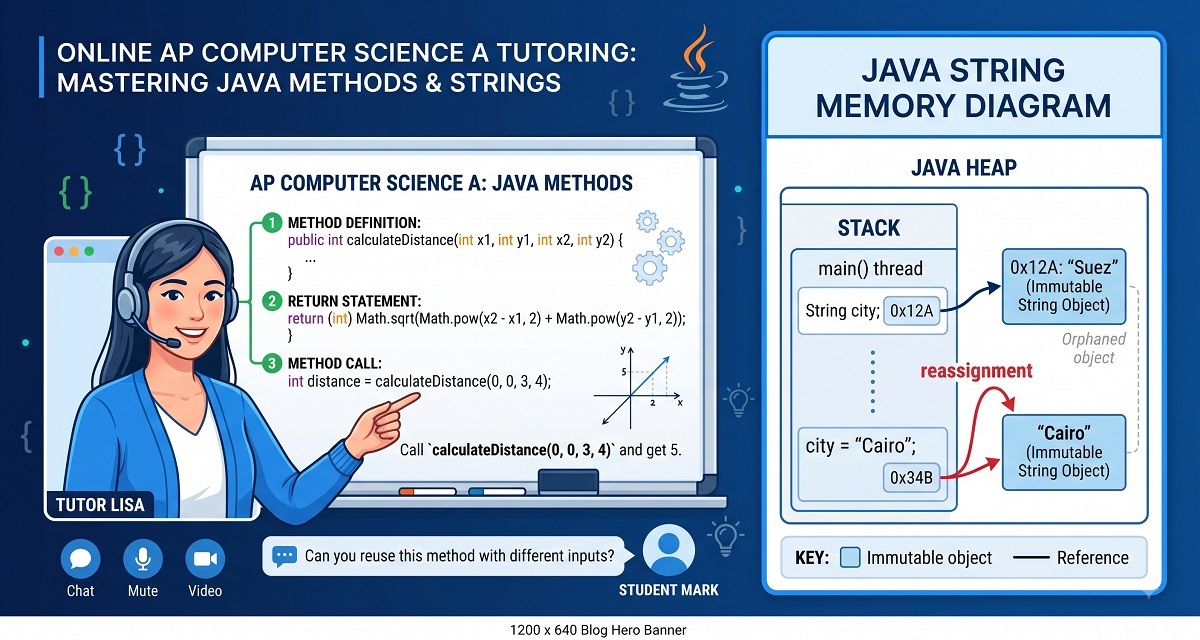
String city = "London";
The variable does not directly contain the characters.
Instead, it stores a reference to a String object somewhere in memory.
When we later write:
city = "Paris";
Java does not modify the original String.
Instead, it creates a completely new String object and changes the variable so it points to the new location.
The original "London" String remains unchanged.
This behavior is called immutability.
Understanding this concept becomes increasingly important later when studying object references, constructors, and memory management.
Primitive Variables vs Objects
During the lesson we compared primitive variables and objects.
Primitive values store their actual data directly.
int age = 17;
Objects work differently.
String name = "Ahmed";
The variable stores an address (reference) rather than the actual object itself.
This distinction explains why Strings, ArrayLists, and other objects behave differently from integers and doubles.
Students who understand this difference usually find later object-oriented programming topics much easier.
Why These Topics Matter on the AP CSA Exam
Java methods and Strings appear throughout the AP Computer Science A curriculum.
Students are expected to:
- write methods
- call methods correctly
- pass parameters
- return values
- trace method execution
- understand object references
- manipulate Strings
- debug common programming mistakes
These skills are assessed in both sections of the AP CSA exam.
Multiple Choice (55%)
Students may be asked to:
- predict program output
- identify compile-time errors
- determine which method is called
- trace String operations
Free Response (45%)
Students regularly write complete Java programs involving:
- methods
- classes
- objects
- ArrayLists
- loops
- conditionals
A solid understanding of methods and object behavior provides a strong foundation for success across the entire exam.
Practical Tips for AP CSA Students
Here are a few habits that consistently help students improve:
- Write small reusable methods instead of one large program.
- Practice tracing code on paper before running it.
- Predict outputs before pressing Run.
- Always check whether a method should return a value.
- Draw simple memory diagrams to visualize object references.
- Review mistakes rather than simply correcting them.
- Complete coding exercises regularly instead of only reading notes.
These habits not only improve exam performance but also develop the mindset used by professional software engineers.
📺 Watch the Full Lesson
Watch the complete tutoring session and follow each coding example step by step.
👉 Lesson Recording:
[Insert Lesson Recording ]
📊 Download the Presentation Slides
Review the diagrams, Java examples, and practice exercises from this lesson.
👉 Presentation Slides:
[Insert Slides Link]
💻 Practice Resources
Continue practicing with these excellent resources:
- CodingBat Java: https://codingbat.com/java
- CS Awesome (Runestone Academy): https://runestone.academy/ns/books/published/csawesome/
- Oracle Java Tutorials: https://docs.oracle.com/javase/tutorial/
- College Board AP Computer Science A: https://apcentral.collegeboard.org/courses/ap-computer-science-a
Conclusion
Mastering Java methods, method calls, return statements, and String immutability is a major milestone in AP Computer Science A. Although these topics are introduced early in the course, they continue to appear in almost every unit that follows, including object-oriented programming, arrays, ArrayLists, recursion, and the AP Computer Science A free-response questions.
During this tutoring session, we focused on understanding the reasoning behind Java rather than simply memorizing syntax. Breaking the distance formula into smaller reusable methods demonstrated how professional programmers approach problem-solving, while exploring String immutability highlighted one of Java's fundamental object-oriented principles.
One of the biggest improvements I see in students is when they stop asking, "What code should I write?" and start asking, "How should I structure the solution?" Developing that mindset not only leads to better AP exam performance but also builds skills that transfer directly into university computer science courses and real-world software engineering.
If you're preparing for the AP Computer Science A exam, don't rush through these fundamentals. Investing time in understanding reusable methods, parameter passing, return values, and object references will make the rest of the course much more manageable.
Frequently Asked Questions
1. What is the difference between a method definition and a method call?
A method definition contains the instructions for a task, while a method call executes those instructions. Defining a method alone does not run it—you must call it from another part of your program.
2. Why should I split a large problem into multiple methods?
Breaking a complex problem into smaller methods makes your code easier to read, test, debug, and reuse. It also reflects good software engineering practice and aligns with the computational thinking skills assessed in AP Computer Science A.
3. Why do methods need return statements?
If a method has a return type (such as int, double, or String), Java requires it to return a value. Without a valid return statement, the program will not compile.
4. Why are Java Strings immutable?
Strings are immutable because once a String object is created, its contents cannot be changed. When you appear to modify a String, Java creates a new String object instead. This design improves performance, security, and memory management.
5. How can I improve at Java methods for the AP CSA exam?
The best approach is consistent practice. Write small reusable methods, trace your code by hand, predict outputs before running programs, and solve past AP-style questions. Understanding the logic behind method calls is much more valuable than memorizing code.
Author Bio
Ahmed Elmalla is a Computer Science educator, Certified Cambridge International AS & A Level Computer Science (9618) teacher, and software engineer with over 20 years of teaching, software engineering, and international tutoring experience. He specializes in AP Computer Science A (Java) and Cambridge IGCSE (0478) and AS & A Level Computer Science (9618), helping students build strong programming, computational thinking, and exam-solving skills. Through his Learn with Kemo platform, he has mentored students from around the world using practical, exam-focused instruction tailored to each learner's needs. His lessons combine real-world software engineering experience with personalized one-to-one tutoring, making complex Java and Computer Science concepts easier to understand. Ahmed is passionate about helping students gain confidence, improve academic performance, and achieve outstanding results in international Computer Science examinations.
LinkedIn: https://www.linkedin.com/in/akelmalla
WhatsApp: https://wa.me/60194028484