18 AP Computer Science A Teaching Strategies That Help Students Learn Java Faster
18 AP Computer Science A Teaching Strategies That Help Students Learn Java Faster
Focus Keyword: AP Computer Science A Teaching Strategies
Related Keywords: AP Computer Science classroom activities, Java teaching methods, AP CSA lesson ideas, Pair Programming, Parsons Problems, Code Tracing, Active Learning in Computer Science, AP CSA pedagogy
Teaching AP Computer Science A (AP CSA) is about much more than explaining Java syntax. Students aren't just learning a programming language—they're learning an entirely new way of thinking. Concepts such as object-oriented programming (OOP), method overloading, recursion, reference semantics, and parameter passing require students to build mental models that they have never encountered before.
After nearly two decades working as a software engineer in industrial automation, medical software, AI, and machine vision before transitioning into education, I've discovered that students rarely struggle because Java is inherently difficult. More often, they struggle because these invisible programming concepts are introduced without enough visualization, interaction, or structured practice.
This realization transformed my teaching philosophy. Instead of relying primarily on lectures and coding demonstrations, I combine active learning, collaborative problem-solving, unplugged activities, and software engineering practices to help students truly understand Java rather than simply memorize it. Many of these strategies align closely with the instructional approaches recommended by the College Board AP Computer Science A curriculum.
Why Many AP Computer Science A Students Find Java Difficult
One observation has remained consistent across my years of teaching and online tutoring.
Students usually make rapid progress during the first few Java lessons. Variables, arithmetic operations, and simple if statements seem straightforward. The real challenges begin when object-oriented programming enters the curriculum.
During tutoring sessions, I frequently see students struggle with concepts such as:
-
Object-Oriented Programming (OOP)
-
Recursion
-
Method Overloading
-
Constructors
-
Static versus Instance Methods
-
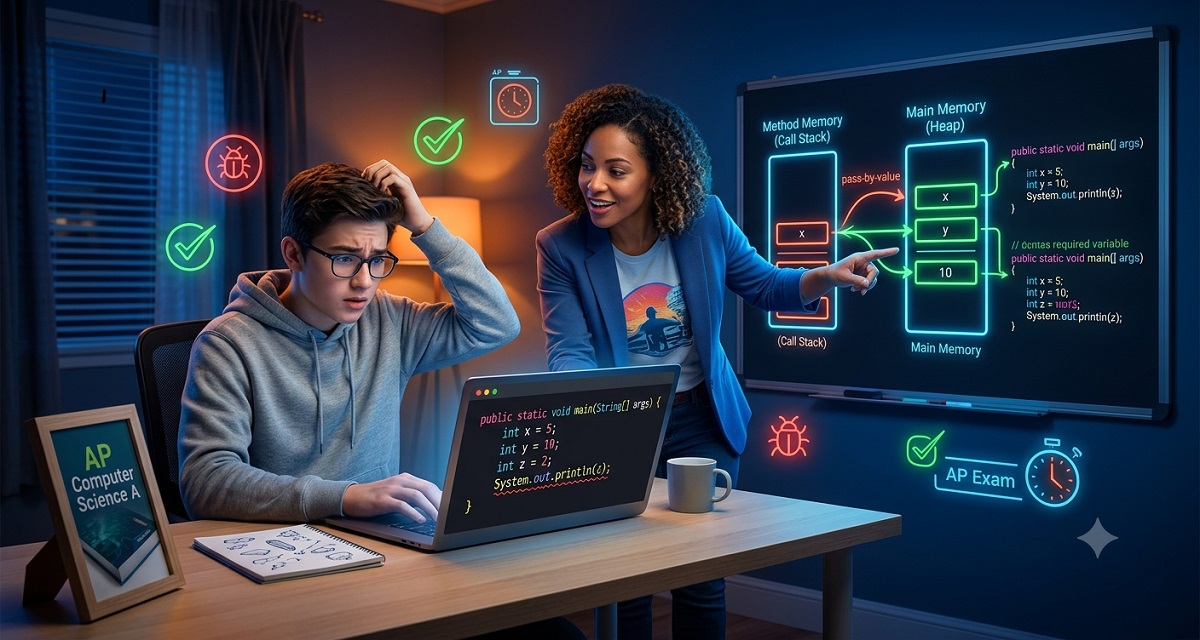
Passing Variables by Value
-
Reference Semantics
-
Arrays and ArrayLists
Among these topics, object-oriented programming, recursion, and reference semantics are by far the most common stumbling blocks. Students often memorize rules such as "Java passes primitives by value" without actually understanding what happens in memory. Once the exam introduces unfamiliar code, memorization quickly falls apart.
Helping students visualize program execution instead of memorizing syntax has produced far better learning outcomes.
How My Software Engineering Career Changed My Teaching
Before becoming a full-time Computer Science educator, I spent many years developing software for industrial automation systems.
My projects included:
-
Multi-axis motion control systems
-
PLC-controlled machinery
-
Machine vision inspection systems
-
Medical software applications
-
RFID manufacturing equipment
-
AI and healthcare startup development
When debugging industrial machines, engineers never relied solely on verbal explanations. We created flowcharts, timing diagrams, simulations, and visual representations of every process.
Programming education benefits from the same approach.
Students don't usually need another lecture.
They need better mental models.
That philosophy now shapes every AP Computer Science A lesson I teach.
Collaborative Learning Strategies
Pair Programming
Pair Programming is one of the most effective collaborative learning techniques recommended for AP Computer Science A.
Instead of working independently, two students share one computer.
One student becomes the Driver, responsible for typing the code.
The second student becomes the Navigator, reviewing every line, predicting errors, suggesting improvements, and thinking ahead.
After a set period, the students switch roles.
This simple strategy dramatically improves code quality because students explain their thinking aloud instead of silently writing code. In my tutoring sessions, I frequently ask students to explain why a method should return a value or why a variable must remain private before allowing them to write the solution.
Teaching someone else is one of the fastest ways to discover gaps in understanding.
Think–Pair–Share
Many students hesitate to answer programming questions because they fear making mistakes.
Think–Pair–Share reduces that anxiety.
Students first solve a problem individually.
Next, they compare their ideas with a partner.
Finally, pairs present their reasoning to the class.
For example, before introducing binary search, students predict how they would search for a target value. Comparing different approaches naturally leads to discussions about algorithm efficiency without immediately introducing formal notation.
Jigsaw Learning
The Jigsaw strategy transforms students into subject experts.
Each group becomes responsible for mastering one programming topic, such as:
-
Arrays
-
Recursion
-
Inheritance
-
Polymorphism
-
Searching Algorithms
Students then join mixed groups where each member teaches their assigned topic to the others.
Explaining programming concepts forces students to organize their thinking far more deeply than passive listening.
Sharing and Responding
Before students begin coding, I often ask them to write their algorithm in plain English or pseudocode.
Students exchange their solutions and attempt to follow each other's instructions.
This simple exercise quickly reveals vague instructions, missing steps, and logical errors before any Java code is written.
Professional software engineers perform similar design reviews before implementation.
"See Two Before Seeing Me"
This classroom protocol encourages independence.
Instead of immediately asking the teacher for help, students must:
-
Review their notes.
-
Ask two classmates.
-
Compare possible solutions.
Only then do they seek teacher assistance.
Besides reducing repetitive questions, this approach develops debugging confidence—one of the most valuable programming skills students can acquire.
Kinesthetic and Unplugged Activities
Programming doesn't always require a computer.
Some of the most memorable Computer Science lessons happen away from the keyboard.
Unplugged Activities
To explain binary search, I ask students to line up while holding numbered cards.
One student searches randomly.
Another uses binary search.
Within minutes, students experience why binary search is dramatically faster than sequential searching.
The lesson becomes memorable because students physically experience the algorithm rather than simply reading about it.
Kinesthetic Boolean Logic
Boolean logic becomes much easier when students participate physically.
Students stand if a condition evaluates to true.
They sit if the condition evaluates to false.
Adding conditions using AND, OR, and NOT immediately demonstrates logical operators without requiring any Java syntax.
Role-Playing Method Calls
One activity that consistently helps students understand parameter passing involves role-playing Java methods.
Students represent:
-
main() -
Other methods
-
Variables
-
Memory
-
The console
Objects such as foam balls or cards represent parameter values.
When students physically pass values between methods, they quickly understand why primitive variables remain unchanged after a method call, while object references behave differently.
This same activity has helped many of my AP Computer Science A tutoring students finally understand pass-by-value, reference semantics, and return values.
Paper Code Scrambles
Instead of writing Java programs from scratch, students receive printed code that has been cut into individual lines.
Working in teams, they reconstruct the correct program.
These Parsons-style activities reduce cognitive load by allowing students to focus on program logic rather than syntax.
Physical Object Labeling
Object-Oriented Programming becomes much clearer when students label real-world objects.
For example, a water bottle becomes an object.
Students identify:
-
Class Name
-
Object Name
-
Attributes
-
Methods
This activity bridges abstract programming concepts with familiar physical objects.
Teaching Students to Think Like Programmers
Professional programmers spend more time reading and debugging code than writing it.
Students should develop the same habits.
Code Tracing
Instead of immediately running a program, students manually trace variable values using a table.
This develops logical reasoning while reducing careless mistakes.
Predict and Confirm
Students first predict program output.
Only afterward do they compile and compare their predictions.
When their prediction differs from the actual output, meaningful learning occurs.
Error Analysis
Rather than always writing new programs, students analyze programs containing intentional errors.
They identify:
-
Syntax errors
-
Logic errors
-
Runtime errors
Debugging strengthens understanding more effectively than repetitive coding exercises.
Scaffolding, Differentiation, and Accessibility
One of the biggest mistakes new Computer Science teachers make is expecting students to solve complex programming problems independently before they have built the necessary foundation. Programming is a cumulative skill. Students need structured support initially, followed by a gradual release of responsibility as their confidence and competence grow.
During my AP Computer Science A tutoring sessions, I often work with students who have already covered a topic in school but still feel lost. Most of the time, the issue isn't intelligence—it's that they were asked to solve problems that exceeded their current understanding without enough scaffolding.
Scaffolding
Scaffolding means providing temporary support while students develop new skills.
For example, instead of asking students to write a complete Java class from scratch, I first provide:
-
The class name
-
Instance variables
-
Method headers
-
Comments describing each step
Students then complete one section at a time.
As their confidence grows, I gradually remove these supports until they can build complete programs independently.
This mirrors how junior software engineers learn in industry. They rarely begin with a blank screen. Instead, they work from existing codebases, templates, and examples before developing completely independent solutions.
Parsons Problems
One of my favorite classroom activities is the Parsons Problem.
Rather than asking students to write an entire Java program, I provide every required line of code—but in the wrong order.
Students must rearrange the statements to create a working solution.
This simple change dramatically reduces cognitive load because learners can focus on program logic instead of remembering every semicolon, bracket, or keyword.
Parsons Problems are particularly effective for students who:
-
are new to programming
-
are English language learners
-
struggle with Java syntax
-
understand the algorithm but not the exact code
Research consistently shows that reducing unnecessary cognitive load allows students to focus their mental effort on problem solving rather than syntax memorization.
Universal Design for Learning (UDL)
Every classroom contains learners with different strengths, backgrounds, and learning preferences.
Universal Design for Learning (UDL) encourages teachers to present information in multiple ways.
Instead of relying only on code examples, I combine:
-
diagrams
-
animations
-
flowcharts
-
physical demonstrations
-
live coding
-
storytelling
-
real-world software examples
When teaching objects and classes, for example, I often compare them to real-world products like cars or smartphones before introducing Java syntax. Students immediately understand that every object has attributes (state) and methods (behavior).
Providing multiple ways to access the same concept makes programming more inclusive and significantly improves retention.
Project-Based Learning (PBL)
Programming becomes meaningful when students create something they care about.
Rather than completing isolated exercises, I encourage students to build small projects such as:
-
Library Management Systems
-
Student Grade Calculators
-
Pokémon battle simulations
-
Banking applications
-
Hotel booking systems
-
Simple games
Projects naturally combine multiple programming concepts including:
-
classes
-
methods
-
arrays
-
loops
-
object-oriented programming
Students also experience software development in a way that resembles real-world engineering projects rather than disconnected textbook exercises.
Vocabulary Organizers and Word Walls
Computer Science introduces hundreds of new technical terms.
Many AP CSA students confuse concepts such as:
-
class vs object
-
parameter vs argument
-
method vs constructor
-
reference vs variable
-
instance vs static
Maintaining a vocabulary journal or digital glossary helps students build precise technical language.
I also encourage students to include:
-
definitions
-
diagrams
-
Java syntax
-
real code examples
rather than memorizing dictionary definitions alone.
Classroom Models and Gamification
Keeping students engaged throughout an entire programming course requires more than interesting content. The overall structure of lessons also matters.
The Flipped Classroom
The Flipped Classroom has become one of my preferred teaching models.
Instead of spending valuable class time delivering lengthy lectures, students first watch short instructional videos before the lesson.
Class time is then dedicated to:
-
solving problems
-
debugging code
-
pair programming
-
asking questions
-
completing AP-style FRQs
This model also works exceptionally well for online tutoring.
Students can revisit recorded lessons whenever they need revision while live sessions focus entirely on problem solving and exam preparation.
Daily Hooks
Every lesson should begin with curiosity.
A simple five-minute activity can dramatically increase student engagement.
Examples include:
-
predicting the output of mysterious Java code
-
identifying hidden programming bugs
-
solving a quick logic puzzle
-
demonstrating a real-world application of the day's concept
Students become naturally curious before formal instruction even begins.
Reciprocal Teaching
One of the strongest indicators of understanding is the ability to teach someone else.
In Reciprocal Teaching, students explain programming concepts to their classmates.
For example, after tracing a complex nested loop, one group explains every iteration on the whiteboard while classmates ask questions.
Students frequently notice misconceptions that would have remained hidden during silent individual work.
Grudgeball
Review sessions do not need to feel like exams.
Grudgeball combines programming questions with friendly competition.
Teams answer AP Computer Science questions.
Correct answers earn the opportunity to score points—or remove points from competing teams—by throwing a soft ball into a classroom target.
Besides making revision enjoyable, Grudgeball encourages discussion, teamwork, and healthy competition before major assessments.
Which Teaching Strategies Work Best for AP Computer Science A?
Although every strategy has value, my experience teaching in schools and tutoring students online suggests that a small group consistently produces the greatest improvement.
The five approaches I rely on most are:
-
Pair Programming – Encourages discussion, teamwork, and debugging skills.
-
Code Tracing – Builds the logical thinking needed for multiple-choice questions and Free Response Questions (FRQs).
-
Parsons Problems – Helps beginners focus on logic instead of syntax.
-
Role-Playing Program Execution – Makes abstract concepts like method calls, recursion, and reference semantics visible.
-
Project-Based Learning – Connects classroom theory with practical programming.
These strategies are particularly effective when teaching the topics students typically find most challenging, including object-oriented programming, recursion, arrays, ArrayLists, and reference semantics.
How I Use These Strategies During AP Computer Science A Tutoring
Over the past few years, I have taught AP Computer Science A students from multiple countries through one-to-one online tutoring. One pattern has become clear: students make the fastest progress when lessons are interactive rather than lecture-based.
During a typical tutoring session, I combine several of the strategies described above. We begin by reviewing misconceptions using code tracing, then move into a live coding exercise where students explain their reasoning as they work. When introducing difficult topics such as recursion or passing objects to methods, I use diagrams, role-playing, and visual memory models to make abstract ideas easier to understand. Students then complete AP-style multiple-choice questions and Free Response Questions (FRQs) to apply what they have learned under exam conditions.
My background in industrial software engineering also shapes these lessons. Instead of teaching Java as a collection of isolated syntax rules, I explain why professional developers use concepts such as encapsulation, private variables, modular design, and object-oriented programming in real software projects. Students often tell me that these real-world examples make the material far easier to understand and remember.
Conclusion
Teaching AP Computer Science A successfully requires much more than presenting Java syntax on a projector. Students need opportunities to discuss ideas, visualize program execution, experiment safely, debug code, and connect abstract concepts to real-world applications.
The instructional strategies recommended by the College Board—such as Pair Programming, Think–Pair–Share, Jigsaw, Code Tracing, Parsons Problems, Project-Based Learning, and the Flipped Classroom—provide an excellent framework for building these experiences. Combined with thoughtful scaffolding and active learning, they help students move beyond memorizing code toward developing genuine computational thinking.
Whether you're teaching a full AP Computer Science A course or supporting students through one-to-one tutoring, the goal remains the same: help learners understand how programmers think, not just what programmers type. When students build strong mental models of Java, concepts like recursion, object-oriented programming, and reference semantics become far less intimidating—and much more enjoyable to learn.
Frequently Asked Questions
1. What is the most effective teaching strategy for AP Computer Science A?
There is no single best strategy, but Pair Programming, Code Tracing, and Parsons Problems consistently improve student understanding by encouraging collaboration, logical reasoning, and problem-solving rather than rote memorization.
2. Why do students struggle with Java in AP Computer Science A?
Many students struggle with abstract concepts such as object-oriented programming (OOP), recursion, reference semantics, and passing variables to methods. These topics require strong mental models of how programs execute in memory, which can be difficult to develop through lectures alone.
3. How can teachers make Java more engaging?
Teachers can use unplugged activities, gamification, role-playing, project-based learning, and real-world programming examples to make abstract concepts more concrete and memorable.
4. What are Parsons Problems?
Parsons Problems provide students with all the lines of code needed to solve a problem, but the lines are presented in a random order. Students focus on arranging the code logically instead of writing every line from scratch, reducing cognitive load while reinforcing programming structure.
5. Are these strategies useful for online AP Computer Science A tutoring?
Yes. Many of these approaches—including live code tracing, Think–Pair–Share, screen sharing, interactive whiteboards, and project-based coding—adapt extremely well to online tutoring environments and help students stay actively engaged.
📚 Further Reading and Resources
Official Resources
-
College Board AP Computer Science A Course and Exam Description: https://apcentral.collegeboard.org/courses/ap-computer-science-a
-
Oracle Java Documentation: https://docs.oracle.com/javase/tutorial/
Research and Evidence
-
Education Endowment Foundation – Collaborative Learning: https://educationendowmentfoundation.org.uk/
-
Harvard Project Zero – Thinking Routines: https://pz.harvard.edu/thinking-routines
-
Barbara Oakley – Learning How to Learn: https://www.coursera.org/learn/learning-how-to-learn
Relevant Reddit Discussions
Ready to Improve Your AP Computer Science A Score?
If you're preparing for AP Computer Science A and struggling with Java, object-oriented programming, recursion, reference semantics, or Free Response Questions (FRQs), I offer personalized one-to-one online tutoring designed to build confidence, strengthen problem-solving skills, and help students achieve higher AP exam scores through structured lessons and real-world programming experience.
Author Bio
Ahmed Elmalla is a Computer Science educator, Certified Cambridge International AS & A Level Computer Science (9618) teacher, and software engineer with over 20 years of teaching, software engineering, and international tutoring experience. He specializes in AP Computer Science A (Java) and Cambridge IGCSE (0478) and AS & A Level Computer Science (9618), helping students build strong programming, computational thinking, and exam-solving skills. Through his Learn with Kemo platform, he has mentored students from around the world using practical, exam-focused instruction tailored to each learner's needs. His lessons combine real-world software engineering experience with personalized one-to-one tutoring, making complex Java and Computer Science concepts easier to understand. Ahmed is passionate about helping students gain confidence, improve academic performance, and achieve outstanding results in international Computer Science examinations.
LinkedIn: https://www.linkedin.com/in/akelmalla
WhatsApp: https://wa.me/60194028484


.png)
.png)