Java Static vs Instance Methods, Void vs Return Methods, and Method Overloading: An AP Computer Science A Student's Guide
Java Static vs Instance Methods, Void vs Return Methods, and Method Overloading Explained for AP Computer Science A
One of the biggest challenges I see while tutoring AP Computer Science A students isn't learning Java syntax—it's understanding why Java behaves the way it does.
Many students can write code that compiles, yet they struggle to explain why one method needs an object while another doesn't, why some methods return values while others don't, or why Java allows multiple methods with the same name.
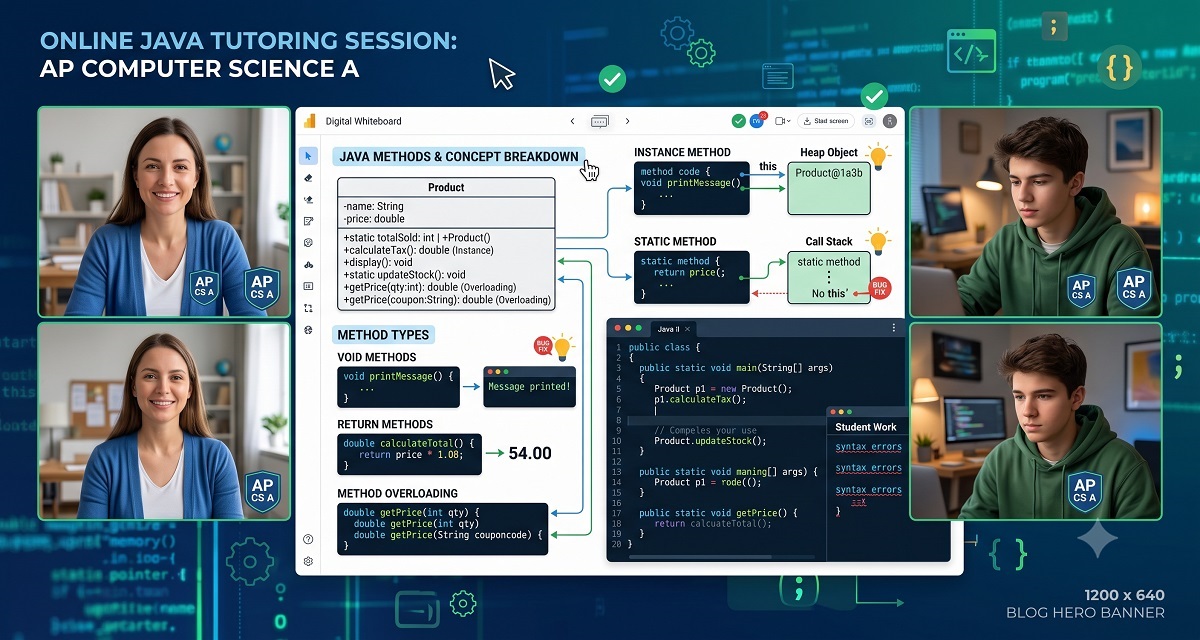
During a recent one-to-one tutoring session with one of my AP Computer Science A students, we focused entirely on these questions. Instead of memorizing definitions, we worked through homework, corrected code together, and connected every concept to real Java programs. Those discussions inspired this article because these same topics appear repeatedly in AP CSA exams and classroom assignments.
Why Java Methods Confuse So Many Students
After teaching Java to high school students and beginners for several years, I've noticed a pattern.
Students usually understand variables first.
Then they learn classes.
After that comes methods—and suddenly everything feels more complicated.
Questions like these become common:
- Why does Math.sqrt() work without creating an object?
- Why does car.displayInfo() require an object?
- Why can't I store the result of a void method?
- What exactly is a method signature?
- How does Java know which overloaded method to execute?
These aren't difficult because the syntax is complicated.
They're difficult because students must understand how Java was designed as an object-oriented language.
📺 Watch the Full Lesson
Watch the complete tutoring session:
🎥 Lesson Recording
(YouTube )
📊 Download the Presentation Slides
Follow the visual explanations used during the lesson.
📄 Java Methods Presentation
(SlideShare )
Reviewing a Real Tutoring Session
The lesson began with reviewing a homework assignment involving a simple Car class.
Although the student had successfully created attributes and a constructor, one important design issue appeared immediately.
Every attribute had been declared public.
This gave us an excellent opportunity to discuss encapsulation, one of the fundamental ideas behind object-oriented programming.
Instead of simply correcting the code, we discussed why experienced software engineers rarely expose class variables directly.
During my years developing industrial automation software, I learned that uncontrolled access to variables often creates bugs that become difficult to trace later in large projects.
The same principle applies whether you're writing software for a manufacturing system or completing an AP Computer Science assignment.
Private attributes protect your objects from accidental changes and make programs easier to maintain.
Static Methods vs Instance Methods
One multiple-choice question in the homework compared two methods:
Math.sqrt()displayInfo()
At first glance, both look like ordinary Java methods.
But they behave very differently.
Static Methods
Static methods belong to the class itself.
They don't need an object.
Examples include:
Math.sqrt(25);

Math.random();

Integer.parseInt("100");
Because these methods don't depend on any particular object, Java allows them to be called directly from the class name.
Instance Methods
Instance methods belong to individual objects.
For example:
Car myCar = new Car();

myCar.displayInfo();
Here, every car object contains its own data.
The method needs that data to work.
Without an object, Java has nothing to display.
One analogy that helped my student was thinking about a calculator versus a specific car.
A calculator's square root function works for everyone.
A car's speed belongs only to that particular car.
Understanding Method Signatures
Another topic that often confuses AP CSA students is method signatures.
Many students believe Java identifies methods by their return type.
It doesn't.
A Java method signature consists of:
- Method name
- Number of parameters
- Parameter data types
- Parameter order
For example:
calculate(int x)

calculate(double x)

calculate(int x, int y)
Although these methods share the same name, Java treats them as different because their signatures differ.
During the lesson, I compared this idea to a handwritten signature.
Two people might share the same name, but their signatures uniquely identify them.
Java uses parameter information in much the same way.
Void Methods vs Return Methods
This was probably the biggest breakthrough of the lesson.
Many students write methods without understanding what the void keyword actually means.
Consider this method:
public static void greeting()
{
    System.out.println("Hello");
}
It performs an action.
But it gives nothing back.
Now compare it with:
public static int square(int x)
{
    return x * x;
}
This method produces a value.
That value can be stored:
int answer = square(6);
Or used immediately:
System.out.println(square(6));
One analogy that worked well during tutoring was a vending machine.
You insert a coin.
The machine returns a drink.
A return method behaves exactly like that.
A void method is more like pressing the elevator button.
Something happens, but nothing comes back into your hand.
Common Mistakes Students Make
After working with many AP Computer Science A students, I see the same mistakes repeatedly.
The most common include:
| Mistake | Why It Happens |
|---|---|
| Calling an instance method without creating an object | Students confuse static and instance methods |
| Forgetting the return statement | Students understand the calculation but forget Java requires returned values |
| Trying to store a void method | Students expect every method to produce data |
| Using public variables everywhere | Lack of understanding of encapsulation |
| Ignoring method signatures | Assuming only method names matter |
The encouraging part is that these mistakes are completely normal.
Most students improve dramatically once they stop memorizing definitions and begin tracing how Java executes each statement.
Method Overloading Made Simple
The session ended by introducing method overloading, another topic that appears frequently in AP Computer Science A.
Method overloading allows several methods to share the same name while accepting different parameters.
For example:
area(double radius)

area(double length, double width)

area(int side)
Java decides which version to execute by examining the method signature.
One interesting question came up during the lesson.
What happens if a method expects a double, but we pass an int?
Java often performs automatic type promotion, converting the integer into a double when no data is lost.
Understanding this behavior helps students answer many AP CSA multiple-choice questions that seem confusing at first.
💻 Practice Resources
To reinforce today's concepts, work through the following:
- Rewrite a class using private attributes instead of public ones.
- Create one static method and one instance method.
- Write both a void method and a return method.
- Create three overloaded methods using different parameter lists.
- Predict which overloaded method Java will execute before running your code.
These exercises build the kind of understanding that goes beyond memorizing syntax and prepares students for both classroom assignments and the AP Computer Science A exam.
Conclusion
Understanding Java methods is one of the biggest milestones in AP Computer Science A. While syntax is important, success on the AP CSA exam comes from understanding how Java thinks.
In this tutoring session, we explored much more than just writing code. We discussed why private attributes make software more reliable, why static methods behave differently from instance methods, how method signatures allow Java to distinguish between overloaded methods, and why void methods and return methods serve different purposes.
As someone who has spent years developing industrial automation software before becoming a Computer Science educator, I've found that students learn these concepts much faster when they see real examples instead of memorizing textbook definitions. Using practical coding exercises, debugging sessions, and visual explanations helps students build the confidence they need for both classroom assignments and the AP Computer Science A exam.
If you're preparing for AP CSA, don't just practice writing code—practice explaining why the code behaves the way it does. That deeper understanding is what separates students who simply pass the exam from those who truly become confident Java programmers.
Frequently Asked Questions
1. What is the difference between a static method and an instance method in Java?
A static method belongs to the class itself and can be called without creating an object, such as Math.sqrt(). An instance method belongs to an object and requires an instance of the class before it can be used.
2. What is a Java method signature?
A method signature consists of the method name, the number of parameters, their data types, and their order. Java uses the method signature—not the return type—to determine which method should be executed.
3. When should I use a void method?
Use a void method when the method performs an action, such as printing information or updating an object, but does not need to return a value.
4. What is method overloading?
Method overloading allows multiple methods to have the same name while using different parameter lists. This makes code easier to read and reuse and is a common topic in AP Computer Science A.
5. Why are private variables recommended?
Private variables support encapsulation, preventing other parts of a program from modifying object data directly. This makes programs more reliable, easier to debug, and easier to maintain.
Author Bio
Ahmed Elmalla is a Computer Science educator, Certified Cambridge International AS & A Level Computer Science (9618) teacher, and software engineer with over 20 years of teaching, software engineering, and international tutoring experience. He specializes in AP Computer Science A (Java) and Cambridge IGCSE (0478) and AS & A Level Computer Science (9618), helping students build strong programming, computational thinking, and exam-solving skills. Through his Learn with Kemo platform, he has mentored students from around the world using practical, exam-focused instruction tailored to each learner's needs. His lessons combine real-world software engineering experience with personalized one-to-one tutoring, making complex Java and Computer Science concepts easier to understand. Ahmed is passionate about helping students gain confidence, improve academic performance, and achieve outstanding results in international Computer Science examinations.
LinkedIn: https://www.linkedin.com/in/akelmalla
WhatsApp: https://wa.me/60194028484


.png)
.png)