Active Learning: From Passive Listening to Purposeful Doing
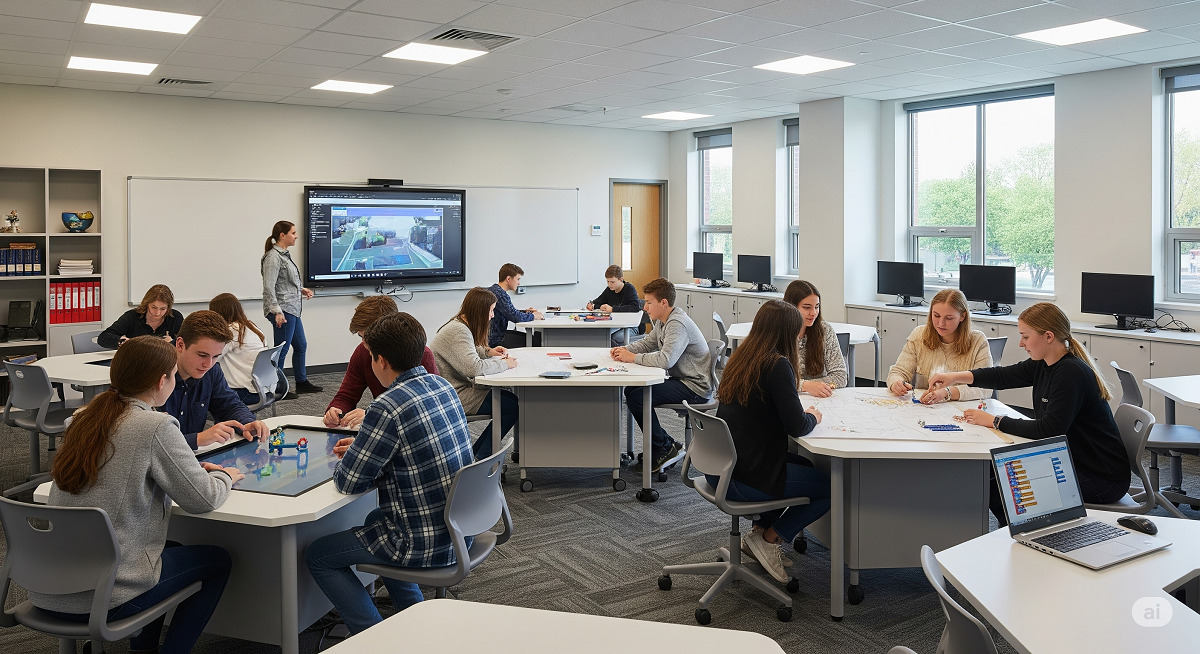
Active learning flips the script: instead of listening about ideas, students work with ideas. When learners participate in meaningful tasks—discussions, problem‑solving, case analysis—they build deeper understanding, stronger skills, and longer‑lasting memory.
The foundations
-
Constructivism: students construct meaning from experiences.
-
Engagement theory: the more students do in authentic ways, the more they learn.
What makes active learning work
-
Participation: frequent, purposeful interaction with content.
-
Collaboration: small‑group tasks that demand talk, coordination, and shared products.
-
Feedback: fast, formative, and specific—so learners adjust in the moment.
Proven techniques (pick a few, do them well)
-
Think‑Pair‑Share: think solo → discuss with a peer → share with class.
-
Problem‑Based Learning (PBL): real‑world problems that require research and reasoning.
-
Peer Teaching: students explain concepts—teaching reveals gaps and solidifies knowledge.
-
Class Debates & Discussions: argue claims with evidence; evaluate counter‑arguments.
-
Case Studies / Concept Acting: analyze scenarios or act out processes to cement ideas.
-
Group Work & Concept Maps: co‑create solutions and visualize connections.
Why it matters
-
Retention improves: doing beats listening.
-
Skills grow: critical thinking, communication, teamwork.
-
Motivation rises: relevance + autonomy = energy.
Make it real in your class
-
Room layout: circles or pods for easy talk and eye contact.
-
Tech that helps: clickers/polls, discussion boards, interactive sims.
-
Variety: rotate methods to match outcomes and learning preferences.
Assess what they’re learning—often
-
Formative checks: polls, minute papers, exit tickets, quick quizzes.
-
Peer assessment: structured rubrics to raise accountability and reflection.
Common hurdles (and quick fixes)
-
Student resistance: explain the why, start small, connect to exams.
-
Time pressure: swap mini‑lectures + targeted activities; reuse templates.
-
Instructor readiness: short PD + one new method per unit = sustainable growth.
Did it work?
-
Student voice: brief surveys, reflective prompts, mid‑course check‑ins.
-
Performance: compare test/project results, track participation patterns.
Bottom line: Active learning isn’t extra—it’s essential. It strengthens thinking, performance, and inclusion, especially for students historically underserved by lecture‑only models.
💡
About the Author
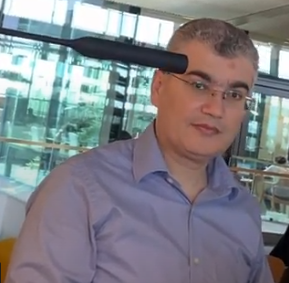
Ahmed Elmalla is a senior ICT and Computer Science teacher at Sky International School in Jalal-Abad, Kyrgyzstan, with more than 19 years of international teaching and software development experience. He is recognized for delivering the Cambridge curriculum (IGCSE & A-Level Computer Science) as well as AP Computer Science A with a focus on deep conceptual understanding and exam readiness.
As a Cambridge ICT teacher in Kyrgyzstan, Ahmed designs structured lessons that combine theory, hands-on coding, and real-world applications. He teaches Python, Java, SQL, and algorithmic thinking while promoting higher-order cognitive skills and independent problem-solving.
His expertise extends to supporting slow learners and students with learning difficulties, using neuroscience-informed strategies and differentiated instruction techniques. This balanced approach has helped students significantly improve their academic confidence and performance.
Currently based in Central Asia, Ahmed also works with international students through online tutoring, serving learners from Malaysia, the United States, Germany, and beyond.
He remains committed to advancing digital education and empowering the next generation of programmers and innovators.